|
Even in this strange and uncertain time, we can find reasons to celebrate. Two big reasons come to mind this month.  April is National Poetry Month, and if ever there was a time to read poetry, it’s now, when many of us have extra reading time and are looking to fill our minds with something other than dire news reports.  This month also brings the 50th anniversary of the first Earth Day next Wednesday, April 22. Though the mass celebrations that had been planned will no longer be possible, we can still commemorate the day. Combining these two celebrations, National Poetry Month and Earth Day, I asked local (and not-so-local) poets to contribute Earth Day poems to today’s blog. I’m happy to share those with you now, along with the collage I created for the occasion. As I worked on the collage, I went back and forth in my mind about whether to portray the vision of a healthy Earth that many of us had on the first Earth Day in 1970 or the reality of Earth in 2020. In the end, I opted for the more hopeful vision, because I want to believe there's still hope. Once the piece was done, however, I noticed it's darker than most of my other collages (many of which are now posted on the COLLAGES page on my website). Perhaps in the end, my Earth Day collage reflects both hope and concern, themes you'll find in the poems below. 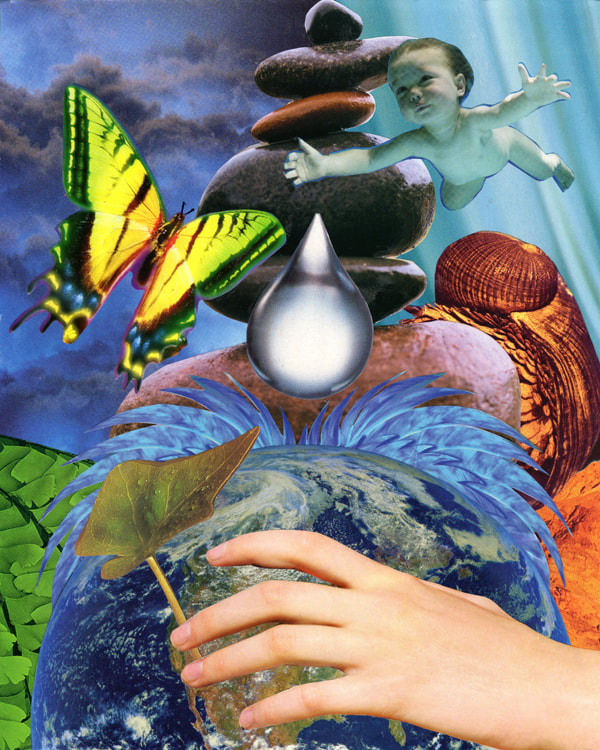 Earth Day 2020 by Nan And now, poetry. Sunset Off Brockway |
| This silent green life and death place. Life bursts forth, buzzing around me. Death underfoot- covering the forest floor. Smelling of earthy must and sweet pine. Fallen trees, once promising, now slowly decaying back into Life-giving soil. Life and Death- existing in this shared space. Life and Death, working hand in hand. Life giving into Death giving into Life. | 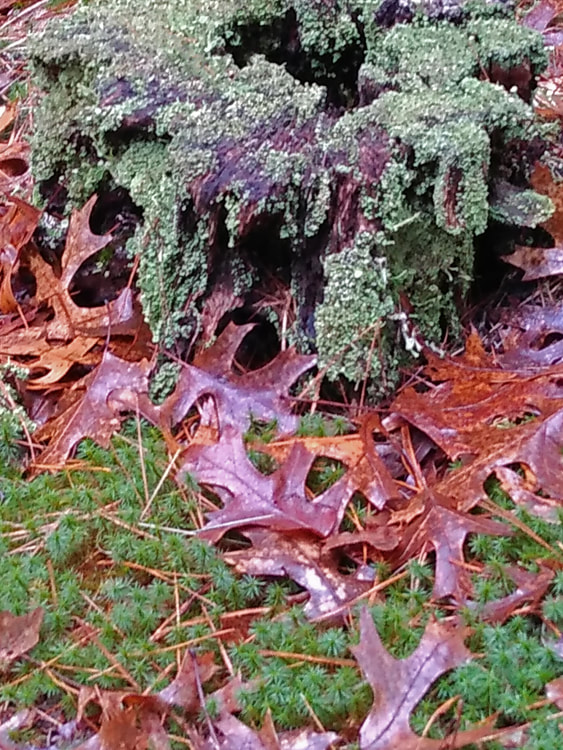 Photo by Katie Clark |

I Think They Will Not Mind
by Marsha Reeves
Ninendaan gaawiin waa-babaamendanzimowaad
I think they will not mind that
wiikaa bi-dagoshinaan.
I arrive late.
Gijiigijigaaneshiiyag gii-giimoodaanagidoowag noopiming
The chickadees were mumbling in the bushes
besho naadazina’iganing.
by the box where I get mail.
Andawendaanaawaa Manaadendamaazowin
They needed an Honor Song
mii wenji-nagamotawagwaa
so I sang to them
nisidawenmangwaa miinawaa
because we understand them again
ezhi-manaadenimangwaa ingiw wiidokawiyangidwaa
the way we respect those who keep us company
gabe biboon
all winter.
Gaawiin da-giizhokoniyesiiwag misawa
They do not need to dress warm and yet
giizhokawiyangidwaa gidode’iminaaning.
they warm our hearts.
I think they will not mind that
wiikaa bi-dagoshinaan.
I arrive late.
Gijiigijigaaneshiiyag gii-giimoodaanagidoowag noopiming
The chickadees were mumbling in the bushes
besho naadazina’iganing.
by the box where I get mail.
Andawendaanaawaa Manaadendamaazowin
They needed an Honor Song
mii wenji-nagamotawagwaa
so I sang to them
nisidawenmangwaa miinawaa
because we understand them again
ezhi-manaadenimangwaa ingiw wiidokawiyangidwaa
the way we respect those who keep us company
gabe biboon
all winter.
Gaawiin da-giizhokoniyesiiwag misawa
They do not need to dress warm and yet
giizhokawiyangidwaa gidode’iminaaning.
they warm our hearts.
* First published on ojibwe.net
Written on the Wind
by Tom Cordle
I am Soulofhawk come to sing my song – may your ears and heart be opened.
I stumble in this foreign tongue and try to make the talk
I speak of when this land was young, and of my brother hawk
My spirit voice is hard to hear, I have so long been gone
But I will whisper in your ear, and having spoke, move on
This finger pushed into the sea of sand and swamp and pine
Has been a welcome home to me – I sing this land of mine . .. .
Of night song sung in joyous trill by every kind of fowl . . .
Of chickadee and whippoorwill . . . of warning from the owl . . .
Of plenty fish and wild oats . . . of berries blue and red
That danced their way down happy throats to bellies always fed . . .
Of rivers coursing through green world of gleaming golden lake . . .
Of alligator, hog and squirrel . . . of moccasin the snake . . .
The screaming panther ruled the pine, the eagle ruled the sky –
Oh, will you hear these words of mine? Will you even try?
I have no words on talking leaves for you to read, my friend
For all this simple man believed was written on the wind.
I stumble in this foreign tongue and try to make the talk
I speak of when this land was young, and of my brother hawk
My spirit voice is hard to hear, I have so long been gone
But I will whisper in your ear, and having spoke, move on
This finger pushed into the sea of sand and swamp and pine
Has been a welcome home to me – I sing this land of mine . .. .
Of night song sung in joyous trill by every kind of fowl . . .
Of chickadee and whippoorwill . . . of warning from the owl . . .
Of plenty fish and wild oats . . . of berries blue and red
That danced their way down happy throats to bellies always fed . . .
Of rivers coursing through green world of gleaming golden lake . . .
Of alligator, hog and squirrel . . . of moccasin the snake . . .
The screaming panther ruled the pine, the eagle ruled the sky –
Oh, will you hear these words of mine? Will you even try?
I have no words on talking leaves for you to read, my friend
For all this simple man believed was written on the wind.
Animal Planet
by Tim Hawkins
While we bow our heads to the ground
and our hearts seek meaning among the stars,
wild creatures assert their presence
in the here and now
and the just here and gone.
Unknowable in the way one speaks
of the alien and other-worldly,
the title to their kingdom is forged
in their absolute
manifestation of the flesh.
If this seems ironic and abstract,
then so be it.
For irony and abstraction
are our great gifts--
not to the world, but to ourselves--
invented for our survival.
And we, of course, are the real aliens;
Each a world unto one’s own,
orbiting a sun of its own devising.
and our hearts seek meaning among the stars,
wild creatures assert their presence
in the here and now
and the just here and gone.
Unknowable in the way one speaks
of the alien and other-worldly,
the title to their kingdom is forged
in their absolute
manifestation of the flesh.
If this seems ironic and abstract,
then so be it.
For irony and abstraction
are our great gifts--
not to the world, but to ourselves--
invented for our survival.
And we, of course, are the real aliens;
Each a world unto one’s own,
orbiting a sun of its own devising.
* First published in Sixfold, July 1, 2013, Summer 2013
Collected in Jeremiad Johnson (In Case of Emergency Press, 2019)
Our Mother (In the Pandemic of 2020)
by Sally C. Kane
Listen!
Do you hear her – Our Great Mother?
In this moment, in time - a reprieve -
when all human activity
has slowed to bare bones minimum,
She inhales an expanse of cleaner air.
Exhales a wasteland of toxins.
Do you hear her – Our Great Mother?
She weeps for us, her children – All
Residents, two-legged and four,
winged, finned and serpentine. We
share the same earth, sea and air.
We, the two-legged ones, hold
the choices in concert with Our Mother.
Even as forces seem out of control, and
the playing field remains unequal.
Do you feel her – Our Great Mother?
She shudders as the sludge venoms
from Frack wells, the vast desolation
from wildfires, and endless wars’ ravages
do a rival dance with the C-virus.
I wonder about this massive
Blue Marble in our universe. The
one we call home. Our Mother.
There’s nowhere else to go. We cannot
just walk off or fly away.
I wonder, if I were an astronaut, or
could hitch a satellite ride, how - in this
Pandemic blink of time –would
Our Mother, our home - look?
Would her greens be greener, her blues
be bluer, her storms less turbulent,
her mass free from veils of smog?
Like a cataclysm, would I see
a rotating orb, vibrating
glimmers of brighter, kinder energy?
Perhaps violet or white? Would
I know – would we all know- we’ve
begun to exercise our choices for love?
Do you hear her – Our Great Mother?
In this moment, in time - a reprieve -
when all human activity
has slowed to bare bones minimum,
She inhales an expanse of cleaner air.
Exhales a wasteland of toxins.
Do you hear her – Our Great Mother?
She weeps for us, her children – All
Residents, two-legged and four,
winged, finned and serpentine. We
share the same earth, sea and air.
We, the two-legged ones, hold
the choices in concert with Our Mother.
Even as forces seem out of control, and
the playing field remains unequal.
Do you feel her – Our Great Mother?
She shudders as the sludge venoms
from Frack wells, the vast desolation
from wildfires, and endless wars’ ravages
do a rival dance with the C-virus.
I wonder about this massive
Blue Marble in our universe. The
one we call home. Our Mother.
There’s nowhere else to go. We cannot
just walk off or fly away.
I wonder, if I were an astronaut, or
could hitch a satellite ride, how - in this
Pandemic blink of time –would
Our Mother, our home - look?
Would her greens be greener, her blues
be bluer, her storms less turbulent,
her mass free from veils of smog?
Like a cataclysm, would I see
a rotating orb, vibrating
glimmers of brighter, kinder energy?
Perhaps violet or white? Would
I know – would we all know- we’ve
begun to exercise our choices for love?
Mother's Milk
by Jessica Mondello
Control and fear became our story
Addiction lies between the lines
And love was lost to pride and glory
This ego virus made us blind
Your mother's dying by your hands
But you won't listen
Her blood is all over your hands
Will you listen
The soul was lost beyond the shadows
The fog will choke us into dust
Collective conscience chose the gallows
The time of man will turn the dust
Your mother's dying by your hands
You won't listen
Her blood is all over your hands
Will you listen
Addiction lies between the lines
And love was lost to pride and glory
This ego virus made us blind
Your mother's dying by your hands
But you won't listen
Her blood is all over your hands
Will you listen
The soul was lost beyond the shadows
The fog will choke us into dust
Collective conscience chose the gallows
The time of man will turn the dust
Your mother's dying by your hands
You won't listen
Her blood is all over your hands
Will you listen
The Soul of Spring
by Kathy Misak
I hear it in the river.
I see it in the buds of the maple.
I hear it in the sounds of the red wing black bird.
Inquisitive cat so happy to be playing outside
Warm breeze on the back of my neck
I see it in the new bright yellow feathers of the gold finch.
I hear it in a distant barking dog.
Ever grateful to be walking this Earth mother experiencing my spring soul
I see it in the buds of the maple.
I hear it in the sounds of the red wing black bird.
Inquisitive cat so happy to be playing outside
Warm breeze on the back of my neck
I see it in the new bright yellow feathers of the gold finch.
I hear it in a distant barking dog.
Ever grateful to be walking this Earth mother experiencing my spring soul
And The Earth Stayed Young
by Tom Cordle
Once the land was green
And the buffalo could roam
The rivers clear and clean
Washed by our simple homes
And all turned in the wheel
And the sacred song was sung
To teach us what was real
And the earth stayed young
Once a man would take
No more than he could use
Set bones back in the lake
When a meal of fish was through
And all turned in the wheel
And the sacred song was sung
To teach us what was real
And the earth stayed young
Once the earth was young
And men saw with their hearts
That everything was one
And man was but a part
And all turned in the wheel
And the sacred song was sung
To teach us what was real
And the earth stayed young
Now the earth is old
The buffalo are gone
The rivers have been sold
And man stands all alone
Let all turn in the wheel
And sing the sacred song
To teach us what is real
So the earth stays young
And the buffalo could roam
The rivers clear and clean
Washed by our simple homes
And all turned in the wheel
And the sacred song was sung
To teach us what was real
And the earth stayed young
Once a man would take
No more than he could use
Set bones back in the lake
When a meal of fish was through
And all turned in the wheel
And the sacred song was sung
To teach us what was real
And the earth stayed young
Once the earth was young
And men saw with their hearts
That everything was one
And man was but a part
And all turned in the wheel
And the sacred song was sung
To teach us what was real
And the earth stayed young
Now the earth is old
The buffalo are gone
The rivers have been sold
And man stands all alone
Let all turn in the wheel
And sing the sacred song
To teach us what is real
So the earth stays young
What Have You Learned
by Jessica Mondello
You can't eat the money
That you've all been praying on
That God has only destroyed you
And you can't drink the oil
You've been pulling out of the ground
Your momma's shaken and torn . . . fool
Do you know what you are
And what you're here for
When it all comes crashing down
What have we learned
Distractions have kept you
From what's really going on
Keeping you away from your mother
Her life source you could tap into
Can heal that broken bond
Yes, you can get there inside you
Do you know what you are
And what you're here for
When it comes crashing all down
What have we learned
That you've all been praying on
That God has only destroyed you
And you can't drink the oil
You've been pulling out of the ground
Your momma's shaken and torn . . . fool
Do you know what you are
And what you're here for
When it all comes crashing down
What have we learned
Distractions have kept you
From what's really going on
Keeping you away from your mother
Her life source you could tap into
Can heal that broken bond
Yes, you can get there inside you
Do you know what you are
And what you're here for
When it comes crashing all down
What have we learned
Pale Blue Seasons
by Tim Hawkins
There is a sudden authority to nightfall
in the flight of a heron, and to the surrounding
darkness where countless feed.
But so much that is unattainable, so much
that lies beyond the sovereign dark, rises up
out of the pale blue season of twilight
like fireflies summoning among the trees
as the moon loses her translucent and ghostly pallor
in the evening’s first clear and troubling dreams.
***
Toward daylight, the deer rise up
from among the flattened grasses
and low-lying hummocks,
emerging in the cool of morning
from indiscernible swales
and cedar swamps,
wary and shy, but alive with owning
at least a part of this
pale blue season of wildflowers.
in the flight of a heron, and to the surrounding
darkness where countless feed.
But so much that is unattainable, so much
that lies beyond the sovereign dark, rises up
out of the pale blue season of twilight
like fireflies summoning among the trees
as the moon loses her translucent and ghostly pallor
in the evening’s first clear and troubling dreams.
***
Toward daylight, the deer rise up
from among the flattened grasses
and low-lying hummocks,
emerging in the cool of morning
from indiscernible swales
and cedar swamps,
wary and shy, but alive with owning
at least a part of this
pale blue season of wildflowers.
* First published in Blueline: June 2011, Volume 32
Collected in Wanderings at Deadline (Aldrich Press, 2012)
You can find links to many more poems on Tim Hawkins's website at https://www.timhawkinspoetry.com/links-to-poems-and-more.html
10 Comments
As I mentioned a couple of weeks ago, social distancing has forced many authors to cancel or postpone readings and book signings they’d scheduled for spring. A dozen of my fellow authors and I got our first taste of this when the West Michigan Women’s Expo, at which we were all selling books (or trying to), was shut down only three hours into what was supposed to be a three-day event.
That’s when I came up with the idea to host a couple of virtual Author Expos on HeartWood. I posted the first one two weeks ago. The second installment opens today.
Here, you can visit the virtual tables of seven authors and check out their varied offerings. If you find a book you love—and how can you not, with this many authors and books?—please consider using some of your unexpected free time to write and post a review on Goodreads, Amazon, or both. The author will thank you and so will readers who learn about the book from your review.
That’s when I came up with the idea to host a couple of virtual Author Expos on HeartWood. I posted the first one two weeks ago. The second installment opens today.
Here, you can visit the virtual tables of seven authors and check out their varied offerings. If you find a book you love—and how can you not, with this many authors and books?—please consider using some of your unexpected free time to write and post a review on Goodreads, Amazon, or both. The author will thank you and so will readers who learn about the book from your review.
HeartWood Author Expo 2 is now open!
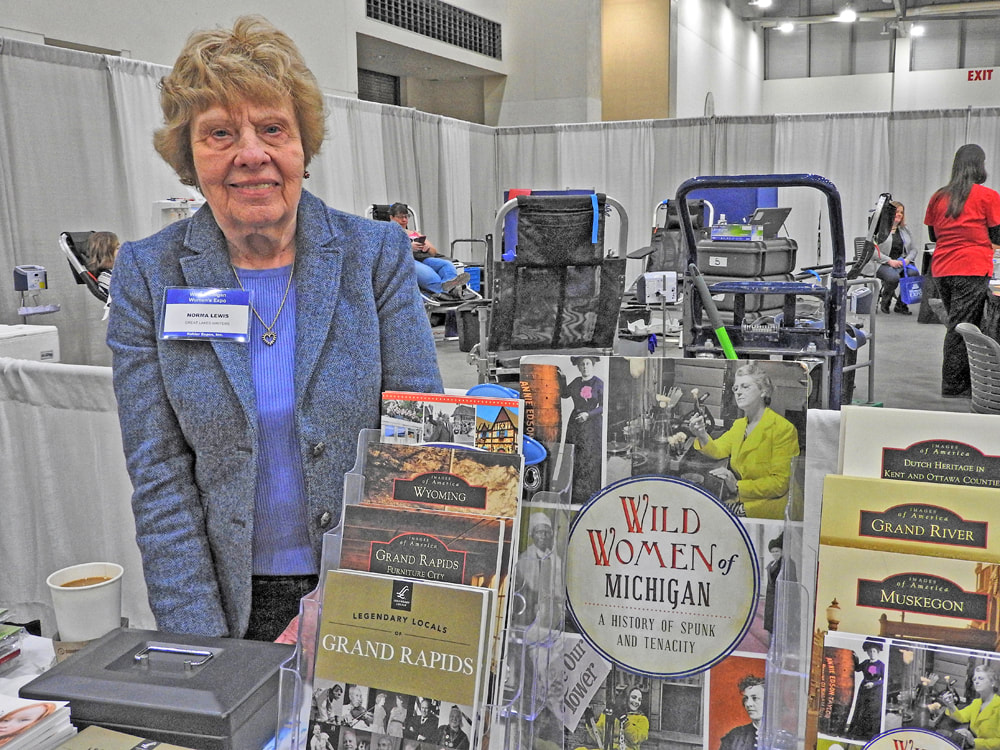
Norma Lewis
Norma Lewis
http://normalewisbooks.com/
Forget San Francisco, Norma left pieces of her heart in Alaska. No cruises or packaged tours for her, she prefers experiencing the state independently via ferry, mail plane, rental car, train, motor-home, bush plane, and an occasional bus. In 2014 she was Jason Mackey’s IditaRider. Many of her Alaska adventures have ended up as magazine articles, though now she is focusing on books.
To be fair, she loves Michigan too, as her books on Michigan history attest. In Norma’s view, history isn’t dates and wars and documents, it’s people and how they reacted to the events that unfolded around them. In researching her books, she’s drawn not to dry facts, but to the quirky.
Norma’s nonfiction titles include Wild Women of Michigan: A History of Spunk and Tenacity; Lost Restaurants of Grand Rapids; Legendary Locals of Grand Rapids; Grand Rapids: Furniture City; 100 Things to Do in Grand Rapids Before You Die; Muskegon; Grand River; Dutch Heritage in Kent and Ottawa Counties; Wyoming; and Connecting the Coasts: The Race to Build the Transcontinental Railroad, and Show Me The World Eskimo-Indian Olympics: Casey Ferguson.
In addition, she is the author of Kasey’s River Song: Spinning Dreams in Gold Rush Alaska; and Dear Santa, I Know It Looks Bad but It Wasn’t My Fault.
Forget San Francisco, Norma left pieces of her heart in Alaska. No cruises or packaged tours for her, she prefers experiencing the state independently via ferry, mail plane, rental car, train, motor-home, bush plane, and an occasional bus. In 2014 she was Jason Mackey’s IditaRider. Many of her Alaska adventures have ended up as magazine articles, though now she is focusing on books.
To be fair, she loves Michigan too, as her books on Michigan history attest. In Norma’s view, history isn’t dates and wars and documents, it’s people and how they reacted to the events that unfolded around them. In researching her books, she’s drawn not to dry facts, but to the quirky.
Norma’s nonfiction titles include Wild Women of Michigan: A History of Spunk and Tenacity; Lost Restaurants of Grand Rapids; Legendary Locals of Grand Rapids; Grand Rapids: Furniture City; 100 Things to Do in Grand Rapids Before You Die; Muskegon; Grand River; Dutch Heritage in Kent and Ottawa Counties; Wyoming; and Connecting the Coasts: The Race to Build the Transcontinental Railroad, and Show Me The World Eskimo-Indian Olympics: Casey Ferguson.
In addition, she is the author of Kasey’s River Song: Spinning Dreams in Gold Rush Alaska; and Dear Santa, I Know It Looks Bad but It Wasn’t My Fault.
Laura Holmes
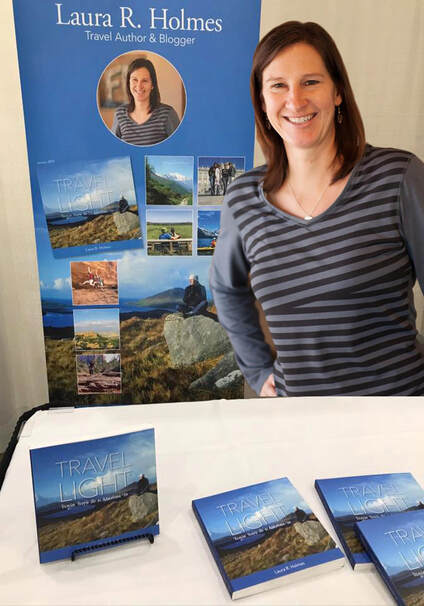
Laura Holmes
https://contentqueens.net/
Author, adventure traveler, volleyballer, biker, hiker, and yogi—Laura is not one to sit still. She’s always on the go, looking for the next big idea. Co-owner of a marketing communications company, FineLine Creative, she advocates life-work-play balance and encourages others to immerse themselves in different places and cultures, as she has through her travel adventures.
In her spare time, Laura writes a monthly travel blog. Her recently-released book Travel Light is a memoir that explores the lighter side of travel with doses of humor, adventure, and personal transformation. Through her stories, she takes readers along on journeys to Italy, Ireland, Spain, France, Alaska, Arizona and her home state of Michigan.
Author, adventure traveler, volleyballer, biker, hiker, and yogi—Laura is not one to sit still. She’s always on the go, looking for the next big idea. Co-owner of a marketing communications company, FineLine Creative, she advocates life-work-play balance and encourages others to immerse themselves in different places and cultures, as she has through her travel adventures.
In her spare time, Laura writes a monthly travel blog. Her recently-released book Travel Light is a memoir that explores the lighter side of travel with doses of humor, adventure, and personal transformation. Through her stories, she takes readers along on journeys to Italy, Ireland, Spain, France, Alaska, Arizona and her home state of Michigan.
Sherry A. Burton
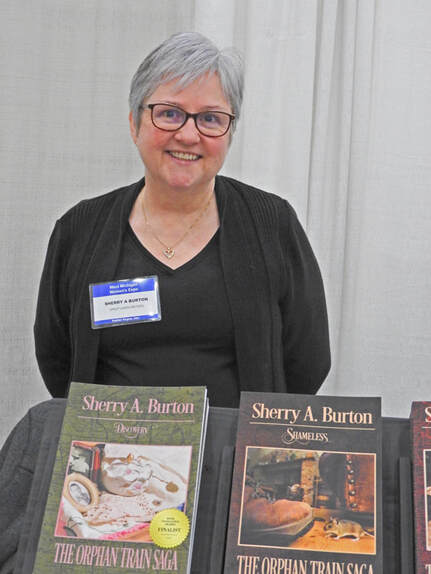
Sherry A. Burton
https://www.sherryaburton.com/
Born and raised in Kentucky, Sherry and her Navy husband lived in nine states before settling in Michigan. She got her start in writing by pledging to write a happy ending for a friend who was going through tough times. The story surprised Sherry by taking over and practically writing itself, and launched her into a new life as an author.
Her historical fiction series, The Orphan Train Saga, follows the stories of children who were transported from Eastern cities to foster homes in the Midwest between 1855 and 1929. While the children in the stories are fictitious, each child’s story is told with the use of history from the era to add flavor and excitement to the tale.
Her other novels include Tears of Betrayal, Love in the Bluegrass, The King of My Heart, Surviving the Storm, Somewhere in My Dreams, Seems Like Yesterday, and Always Faithful.
Sherry also writes children’s books under the name Sherry A. Jones.
Born and raised in Kentucky, Sherry and her Navy husband lived in nine states before settling in Michigan. She got her start in writing by pledging to write a happy ending for a friend who was going through tough times. The story surprised Sherry by taking over and practically writing itself, and launched her into a new life as an author.
Her historical fiction series, The Orphan Train Saga, follows the stories of children who were transported from Eastern cities to foster homes in the Midwest between 1855 and 1929. While the children in the stories are fictitious, each child’s story is told with the use of history from the era to add flavor and excitement to the tale.
Her other novels include Tears of Betrayal, Love in the Bluegrass, The King of My Heart, Surviving the Storm, Somewhere in My Dreams, Seems Like Yesterday, and Always Faithful.
Sherry also writes children’s books under the name Sherry A. Jones.
Robert Muladore
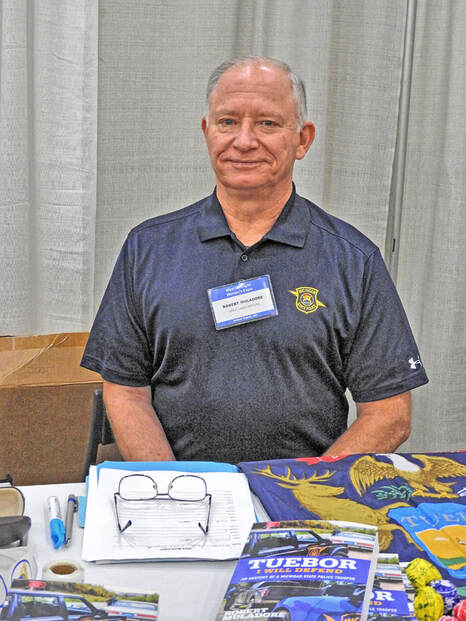
Robert Muladore
http://tueborbooks.com/book/tuebor/
A former Michigan State Police officer, Robert was launched into police work as as the first full-time patrolman with the Bridgeport Township, Michigan police department, initially without the benefit of formal police academy training. After surviving those eighteen months of on-the-job training, he began his career with the Michigan State Police, where he was first assigned as a trooper near Detroit, conducting countless criminal investigations. From there he went on to a variety of assignments over his 25-year career, furthering his education with an associate’s degree in criminal justice, a bachelor’s degree in criminal justice from Madonna University, a Juris Doctorate degree from the Detroit College of Law (now MSU School of Law) and a Ph.D. in Public Affairs and Administration from Western Michigan University. He currently practices civil law and is working on a new book about his experiences as an attorney.
His first book, Tuebor – I Will Defend: An anatomy of a Michigan State Police Trooper, is the story of an honest, hard-working yet naïve young man who chose to leave the safety of civilian life for a career of a dedicated police officer. The book depicts the daily lives of officers and captures the human side of police work.
A former Michigan State Police officer, Robert was launched into police work as as the first full-time patrolman with the Bridgeport Township, Michigan police department, initially without the benefit of formal police academy training. After surviving those eighteen months of on-the-job training, he began his career with the Michigan State Police, where he was first assigned as a trooper near Detroit, conducting countless criminal investigations. From there he went on to a variety of assignments over his 25-year career, furthering his education with an associate’s degree in criminal justice, a bachelor’s degree in criminal justice from Madonna University, a Juris Doctorate degree from the Detroit College of Law (now MSU School of Law) and a Ph.D. in Public Affairs and Administration from Western Michigan University. He currently practices civil law and is working on a new book about his experiences as an attorney.
His first book, Tuebor – I Will Defend: An anatomy of a Michigan State Police Trooper, is the story of an honest, hard-working yet naïve young man who chose to leave the safety of civilian life for a career of a dedicated police officer. The book depicts the daily lives of officers and captures the human side of police work.
Wendy Sura Thomson
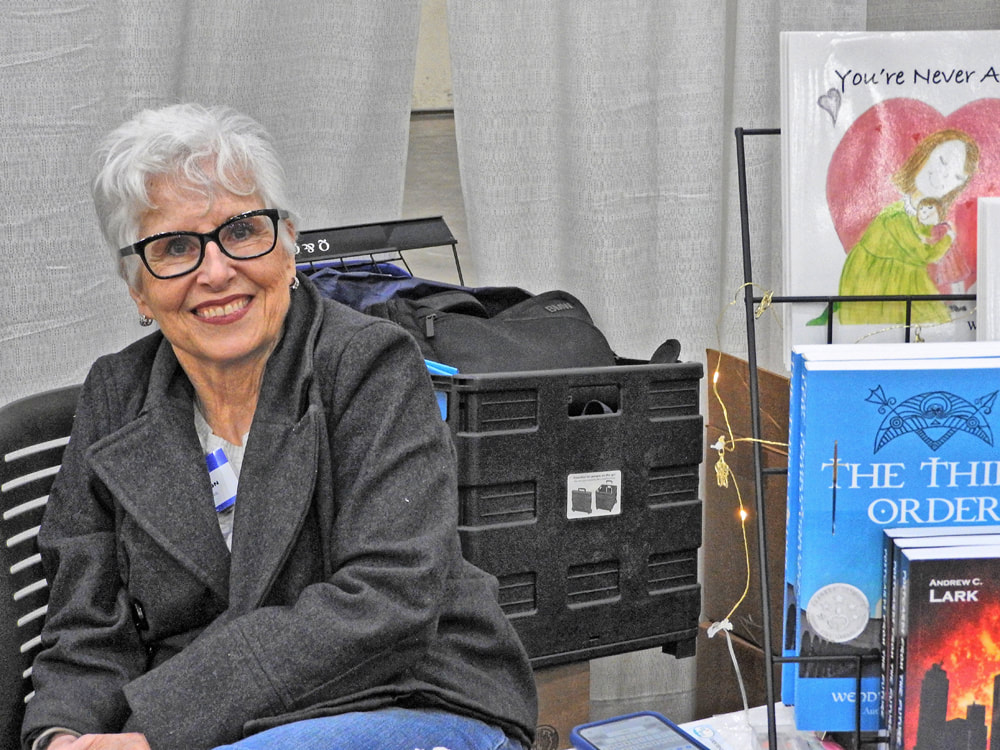
Wendy Sura Thomson
https://www.quittandquinn.com/wendy-sura-thomson
Wendy’s memoir, Summon the Tiger, is a story of surviving and thriving in the face of extraordinary obstacles. Born with congenital skeletal abnormalities, she had a leg amputated as a toddler. Her father suffered from World War II induced PTSD, and her mother was emotionally unstable. Wendy coped by escaping to a world of books and music. But when her father sold everything to buy a freighter and travel around the world, Wendy signed on as navigator. She jumped ship in Miami and headed out on her own, as what was left of her family disintegrated. As she pursued her studies and met a coterie of colorful characters, she was forced to evaluate what was most important to her.
Wendy’s other books include The Third Order and a children’s book, Ted and Ned. In addition, she contributed to Postcards from the Future: A Triptych on Humanity’s End.
Besides writing, Wendy’s pleasures include sipping coffee outdoors first thing in the morning, rain or shine; listening to the waterfall and the birds; and watching—often with amusement—her two beloved Irish Setters explore.
Wendy’s memoir, Summon the Tiger, is a story of surviving and thriving in the face of extraordinary obstacles. Born with congenital skeletal abnormalities, she had a leg amputated as a toddler. Her father suffered from World War II induced PTSD, and her mother was emotionally unstable. Wendy coped by escaping to a world of books and music. But when her father sold everything to buy a freighter and travel around the world, Wendy signed on as navigator. She jumped ship in Miami and headed out on her own, as what was left of her family disintegrated. As she pursued her studies and met a coterie of colorful characters, she was forced to evaluate what was most important to her.
Wendy’s other books include The Third Order and a children’s book, Ted and Ned. In addition, she contributed to Postcards from the Future: A Triptych on Humanity’s End.
Besides writing, Wendy’s pleasures include sipping coffee outdoors first thing in the morning, rain or shine; listening to the waterfall and the birds; and watching—often with amusement—her two beloved Irish Setters explore.
Kimberly Bell Mocini
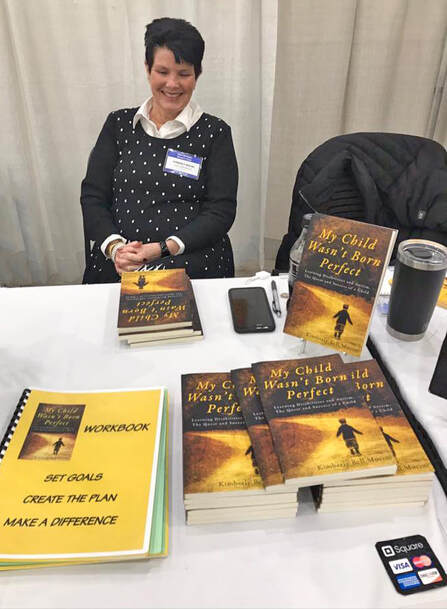
Kimberly Bell Mocini (Photo: Janet Vormittag)
https://principiamedia.com/authors/kimberly-mocini/
Kimberly grew up in Rockford, Michigan and went on to earn a degree in business administration from Aquinas College and to study art at Kendall School of Design. Early in her career, when the microwave oven was first introduced, Kimberly traveled throughout Michigan teaching hundreds the “how to” of microwave cooking. That led to her first foray into publishing, a cookbook called For Better Meals The Microwave Way.
Her more recent book, My Child Wasn’t Born Perfect, is a personal and inspiring story of the challenges she and her family faced while raising a child who had a learning disability that was classified under the autism umbrella.
Kimberly grew up in Rockford, Michigan and went on to earn a degree in business administration from Aquinas College and to study art at Kendall School of Design. Early in her career, when the microwave oven was first introduced, Kimberly traveled throughout Michigan teaching hundreds the “how to” of microwave cooking. That led to her first foray into publishing, a cookbook called For Better Meals The Microwave Way.
Her more recent book, My Child Wasn’t Born Perfect, is a personal and inspiring story of the challenges she and her family faced while raising a child who had a learning disability that was classified under the autism umbrella.
Nan Sanders Pokerwinski
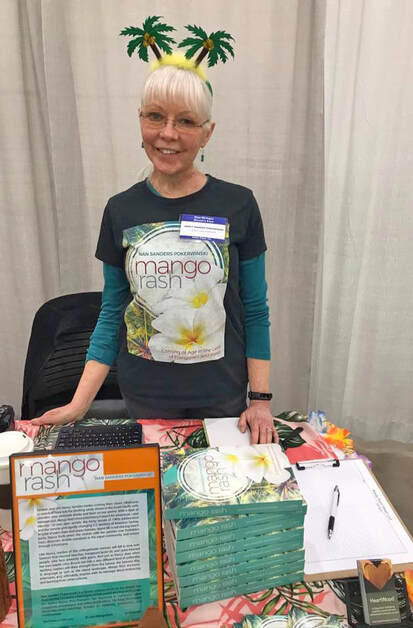
Nan Sanders Pokerwinski (Photo: Janet Vormittag)
http://www.nanpokerwinski.com/
Nan (that’s me!) is a former science writer for the Detroit Free Press and the University of Michigan, whose award-winning work (under the byline Nancy Ross-Flanigan) has appeared in numerous magazines, newspapers, and online publications. Her blog, Heartwood (http://www.nanpokerwinski.com/blog), focuses on creativity, connection, and contentment.
Her memoir Mango Rash: Coming of Age in the Land of Frangipani and Fanta, which won first place in the memoir/nonfiction category of the Pacific Northwest Writers Association literary awards, chronicles her search for adventure—and identity—in two alien realms: the tricky terrain of adolescence and the remote U.S. territory of American Samoa. Against a backdrop of lava-rimmed beaches, frangipani-laced air, and sensual music, she immerses herself in 1960s island culture with a colorful cast of Samoan and American expat kids. The lessons she learns in the process prove invaluable when she’s faced with crises as trivial as a mean girl’s put-down and as staggering as a fire, a hurricane, a drowning, and her own health crisis.
When she’s not writing, Nan takes photographs, makes collages, and wanders the woods around the West Michigan home she shares with her husband Ray Pokerwinski.
Nan (that’s me!) is a former science writer for the Detroit Free Press and the University of Michigan, whose award-winning work (under the byline Nancy Ross-Flanigan) has appeared in numerous magazines, newspapers, and online publications. Her blog, Heartwood (http://www.nanpokerwinski.com/blog), focuses on creativity, connection, and contentment.
Her memoir Mango Rash: Coming of Age in the Land of Frangipani and Fanta, which won first place in the memoir/nonfiction category of the Pacific Northwest Writers Association literary awards, chronicles her search for adventure—and identity—in two alien realms: the tricky terrain of adolescence and the remote U.S. territory of American Samoa. Against a backdrop of lava-rimmed beaches, frangipani-laced air, and sensual music, she immerses herself in 1960s island culture with a colorful cast of Samoan and American expat kids. The lessons she learns in the process prove invaluable when she’s faced with crises as trivial as a mean girl’s put-down and as staggering as a fire, a hurricane, a drowning, and her own health crisis.
When she’s not writing, Nan takes photographs, makes collages, and wanders the woods around the West Michigan home she shares with her husband Ray Pokerwinski.
Tell us about the books and authors you've discovered during this period of isolation.
First of all, it was Friday the 13th. Second of all, there were warnings all around to practice social distancing in light of the coronavirus pandemic. Stay home. Avoid crowds. Cancel big events.
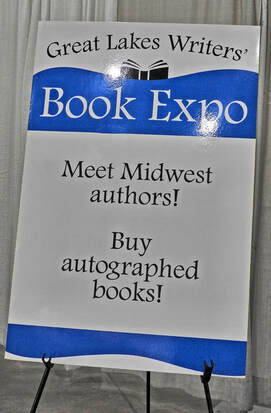
So it was something of a surprise to get word that the West Michigan Women’s Expo, where I was scheduled to sell and sign books last Friday, was still a go. Granted, a few authors who’d reserved space at the event decided against coming, but a dozen or so of us intrepid—or foolhardy—souls showed up at DeVos Place with our books.
The Expo opened at 10:00, and while the crowds weren’t overwhelming, a steady stream of expo-goers ambled through. Book sales were not exactly brisk for the first few hours, but we were all hopeful things would pick up after lunch.
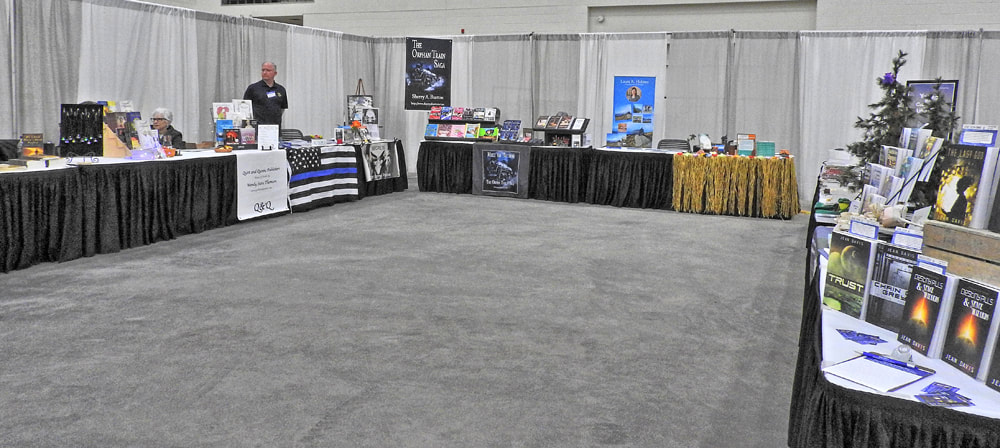
The author expo section, all ready for shoppers. (Guess whose table was wearing a grass skirt.)
Then, around 1:00, the rumors began circulating. The Expo was being shut down, and we’d soon be sent packing. This rumor came in various forms, the most colorful version being that “twenty men in suits” had converged on the conference center and ordered the event closed. A later, more credible report had it that Governor Whitmer herself had issued the directive. (There’s a trenchant comment in there somewhere about one woman doing the work of twenty men (in suits!), but I’ll bypass that for now.)
Given the shutdown and the fact that many authors (including me) may now face cancellation or postponement of other events we’ve worked so hard to arrange, I’ve decided to turn the next two installments of HeartWood into virtual Author Expos.
Instead of strolling through, you can scroll through and visit the virtual tables of the authors you might have met in person at the cancelled event. With this many authors and books, I’ll bet you can find plenty of reading material to keep you occupied during this period of voluntary isolation.
And if you find a book you love, please consider using some of your unexpected free time to write and post a review on Goodreads, Amazon, or both. The author will thank you and so will readers who learn about the book from your review.
The HeartWood Author Expo is now open!
Jean Davis
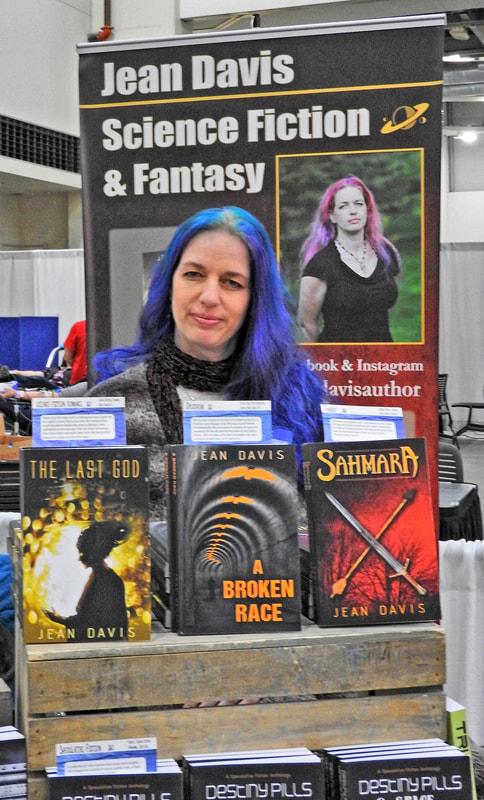
Jean Davis
https://jeanddavis.blogspot.com/
Jean writes speculative fiction. Her novels include Trust, Destiny Pills & Space Wizards, The Last God, A Broken Race and Sahmara. Her short stories have appeared in The 3288 Review, Bards and Sages Quarterly, Theian Journal, Acidic Fiction's Corrosive Chronicles anthology, The First Line, Tales of the Talisman, Brewed Awakenings II anthology, and more.
When not ruining fictional lives from the comfort of her writing chair, she can be found devouring books and sushi, enjoying the offerings of local breweries, weeding her flower garden, or picking up hundreds of sticks while attempting to avoid the abundant snake population who also shares her yard.
Jean writes speculative fiction. Her novels include Trust, Destiny Pills & Space Wizards, The Last God, A Broken Race and Sahmara. Her short stories have appeared in The 3288 Review, Bards and Sages Quarterly, Theian Journal, Acidic Fiction's Corrosive Chronicles anthology, The First Line, Tales of the Talisman, Brewed Awakenings II anthology, and more.
When not ruining fictional lives from the comfort of her writing chair, she can be found devouring books and sushi, enjoying the offerings of local breweries, weeding her flower garden, or picking up hundreds of sticks while attempting to avoid the abundant snake population who also shares her yard.
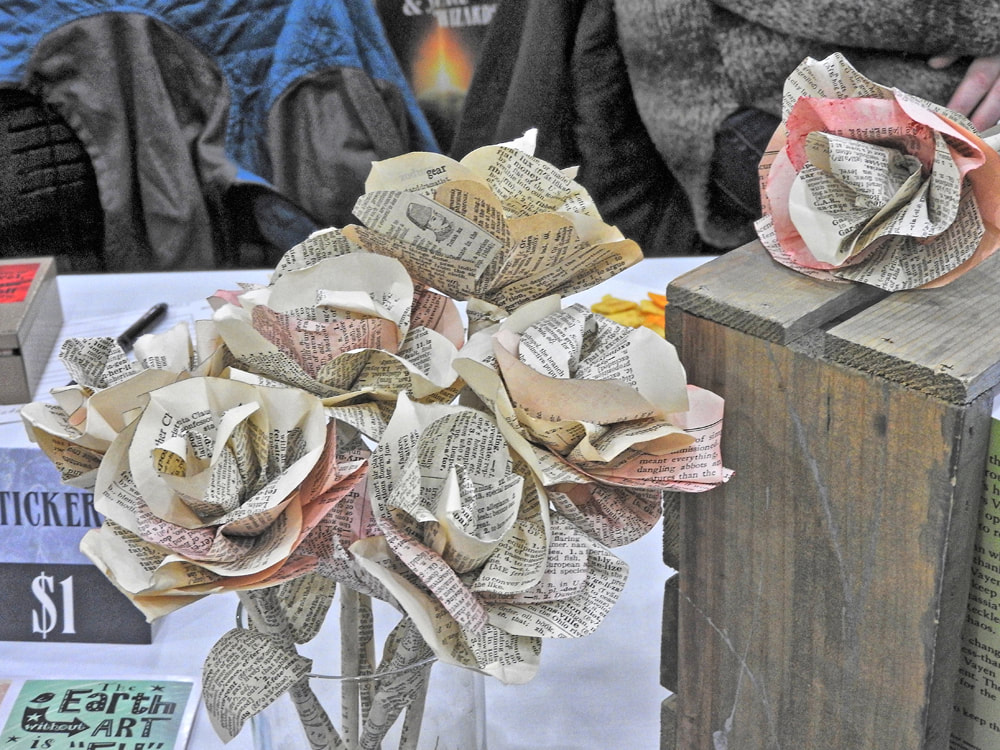
Jean also makes these cool book-page roses
Joan H. Young
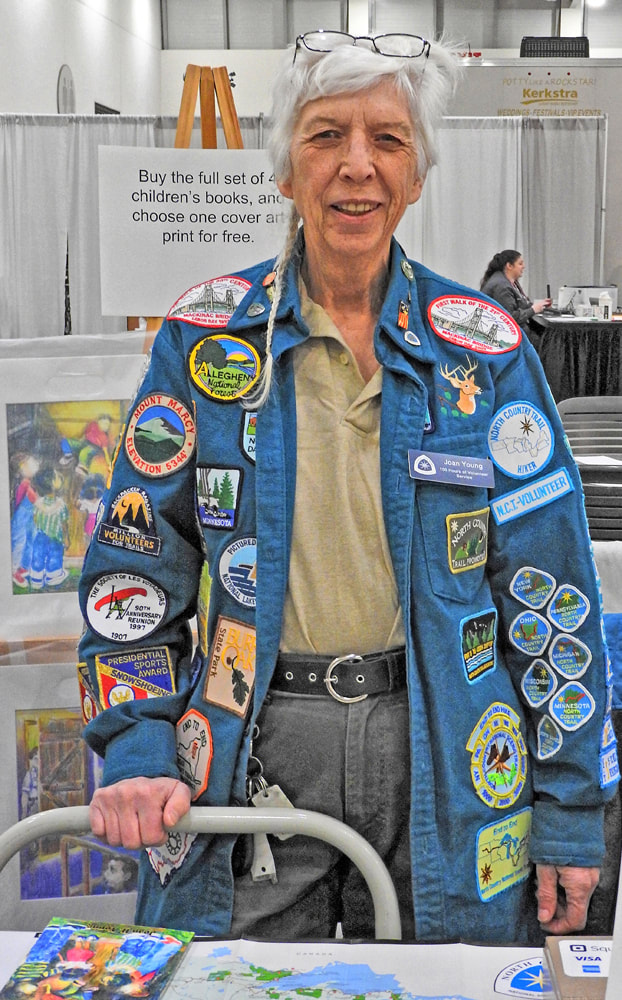
Joan H. Young
http://booksleavingfootprints.com/
A lifelong outdoorsperson, Joan rode a bicycle from the Pacific to the Atlantic Ocean in 1986 and in 2010 became the first woman to complete the North Country National Scenic Trail on foot. Her mileage totaled 4,395 miles.
In addition to North Country Cache and North Country Quest, both about her experiences on the North Country Trail, Joan has written six cozy mysteries in the Anastasia Raven series and four Dubois Files children’s mysteries. Two essay collections, Get Off the Couch with Joan and Fall Off the Couch Laughing contain work originally published as newspaper columns.
A lifelong outdoorsperson, Joan rode a bicycle from the Pacific to the Atlantic Ocean in 1986 and in 2010 became the first woman to complete the North Country National Scenic Trail on foot. Her mileage totaled 4,395 miles.
In addition to North Country Cache and North Country Quest, both about her experiences on the North Country Trail, Joan has written six cozy mysteries in the Anastasia Raven series and four Dubois Files children’s mysteries. Two essay collections, Get Off the Couch with Joan and Fall Off the Couch Laughing contain work originally published as newspaper columns.
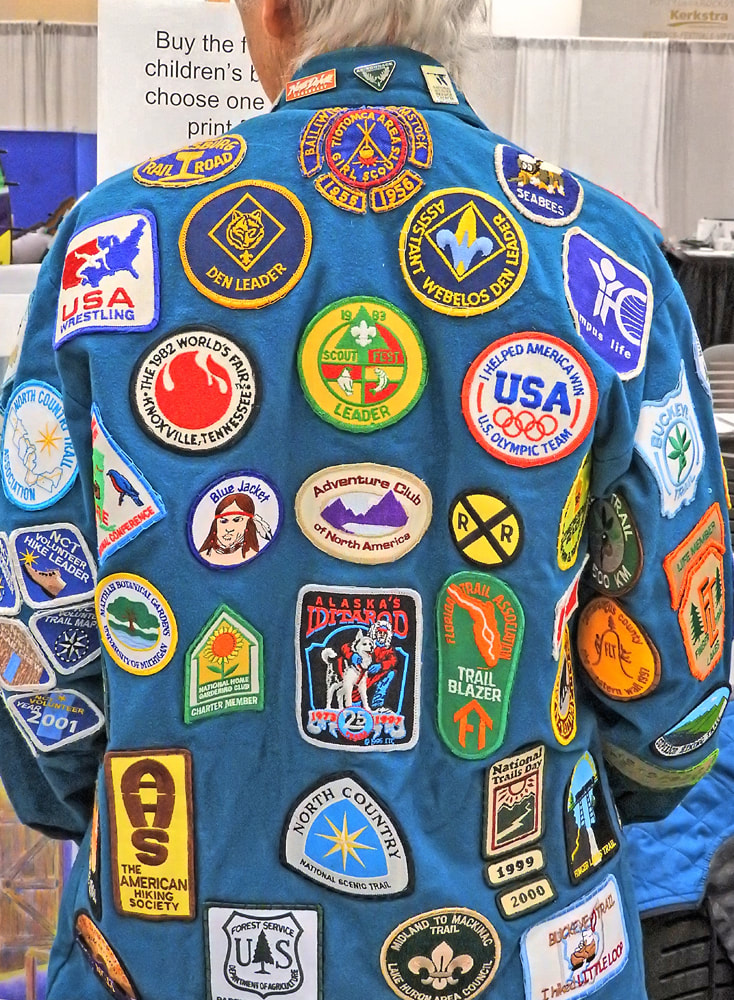
The patches on Joan's jacket are just a sample of all the ones she's collected
Janet Vormittag
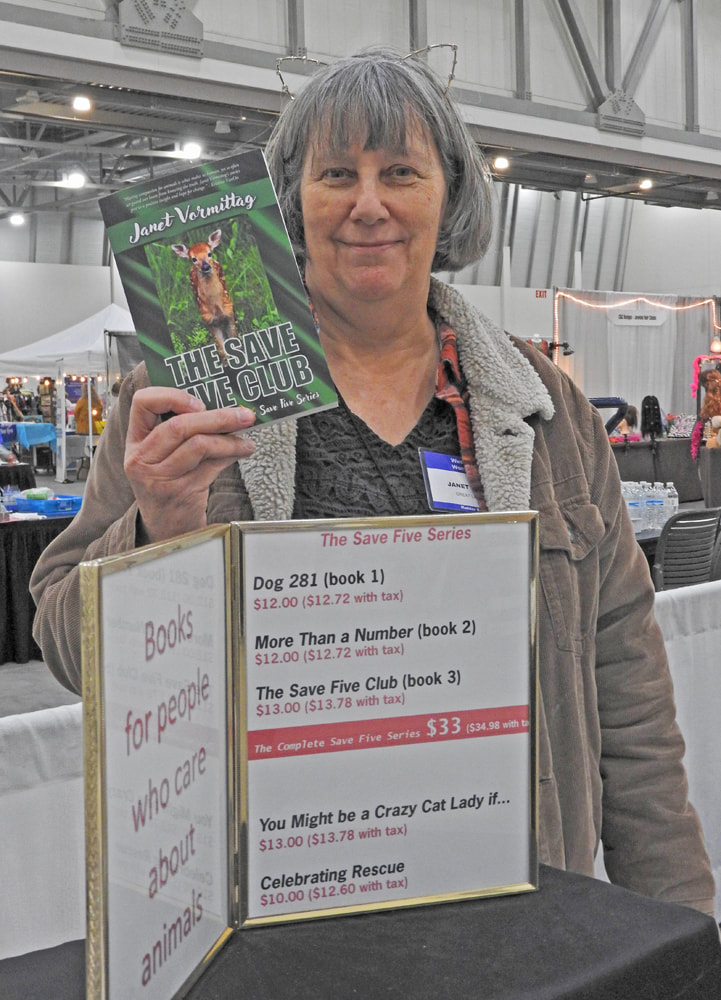
Janet Vormittag
https://www.janetvormittag.com/home.html
Author, publisher, and animal advocate, Janet is the founder and publisher of Cats and Dogs, a Magazine Devoted to Companion Animals, a free publication distributed in West Michigan that promotes pet adoption and spay/neuter.
Janet holds a bachelor’s degree in journalism from Grand Valley State University and was a correspondent for The Grand Rapids Press for ten years. Her articles have also been published in Cat Fancy, The Muskegon Chronicle, and the North Ottawa Weekly. Her true story of taming a feral cat, “Wild Cat I Think You Love Me,” was published in The Ultimate Cat Lover (HCI, 2008).
Janet’s books include You Might be a Crazy Cat Lady if . . . , Dog 281 (Save Five Series Book 1), More Than a Number (Save Five Series Book 2), and the just-published The Save Five Club (Save Five Series Book 3).
Author, publisher, and animal advocate, Janet is the founder and publisher of Cats and Dogs, a Magazine Devoted to Companion Animals, a free publication distributed in West Michigan that promotes pet adoption and spay/neuter.
Janet holds a bachelor’s degree in journalism from Grand Valley State University and was a correspondent for The Grand Rapids Press for ten years. Her articles have also been published in Cat Fancy, The Muskegon Chronicle, and the North Ottawa Weekly. Her true story of taming a feral cat, “Wild Cat I Think You Love Me,” was published in The Ultimate Cat Lover (HCI, 2008).
Janet’s books include You Might be a Crazy Cat Lady if . . . , Dog 281 (Save Five Series Book 1), More Than a Number (Save Five Series Book 2), and the just-published The Save Five Club (Save Five Series Book 3).
Emma Palova
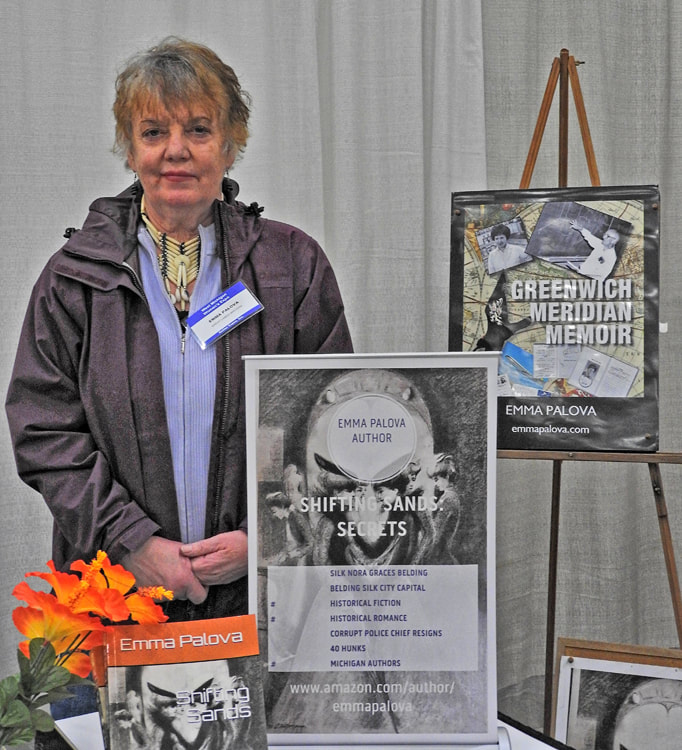
Emma Palova
https://emmapalova.com/
Born in former Czechoslovakia, Emma is a journalist, author, short story writer, and screenwriter based in Lowell, Michigan.
“Small towns in Midwest America continue to inspire my work,” she says. “I find strength in my characters modeled after resilient people in the face of adversity. I love the Lake Michigan shoreline, its beaches and forests.”
Emma’s books include Shifting Sands: Short Stories, Secrets (Shifting Sands Book 2), and Greenwich Meridian Memoir, an epic tale of immigration and love spanning three continents and two generations.
Born in former Czechoslovakia, Emma is a journalist, author, short story writer, and screenwriter based in Lowell, Michigan.
“Small towns in Midwest America continue to inspire my work,” she says. “I find strength in my characters modeled after resilient people in the face of adversity. I love the Lake Michigan shoreline, its beaches and forests.”
Emma’s books include Shifting Sands: Short Stories, Secrets (Shifting Sands Book 2), and Greenwich Meridian Memoir, an epic tale of immigration and love spanning three continents and two generations.
Ellen M. Murray

Ellen M. Murray
https://www.emedspec.com/
Ellen is the creator of Think Spell Write, a reading program for students who struggle to read and write fluently despite having had reading instruction. These might be special education students, students whose education has been disrupted by trauma or interrupted due to frequent moves, or students who have not yet learned phonetic rules well enough to effectively apply them to read.
A 32-year veteran teacher, Ellen taught various subjects at different grade levels, always with dedication to struggling students and a passion for teaching reading.
“I love teaching reading!” she says. “I especially love teaching reading to students who feel they will never learn to read. I love that ‘aha’ moment when reading clicks for a student. I love when students are speechless or red-faced, or their face lights up as they realize ‘I can read this!’ ”
Ellen is the creator of Think Spell Write, a reading program for students who struggle to read and write fluently despite having had reading instruction. These might be special education students, students whose education has been disrupted by trauma or interrupted due to frequent moves, or students who have not yet learned phonetic rules well enough to effectively apply them to read.
A 32-year veteran teacher, Ellen taught various subjects at different grade levels, always with dedication to struggling students and a passion for teaching reading.
“I love teaching reading!” she says. “I especially love teaching reading to students who feel they will never learn to read. I love that ‘aha’ moment when reading clicks for a student. I love when students are speechless or red-faced, or their face lights up as they realize ‘I can read this!’ ”
Brenda Hasse
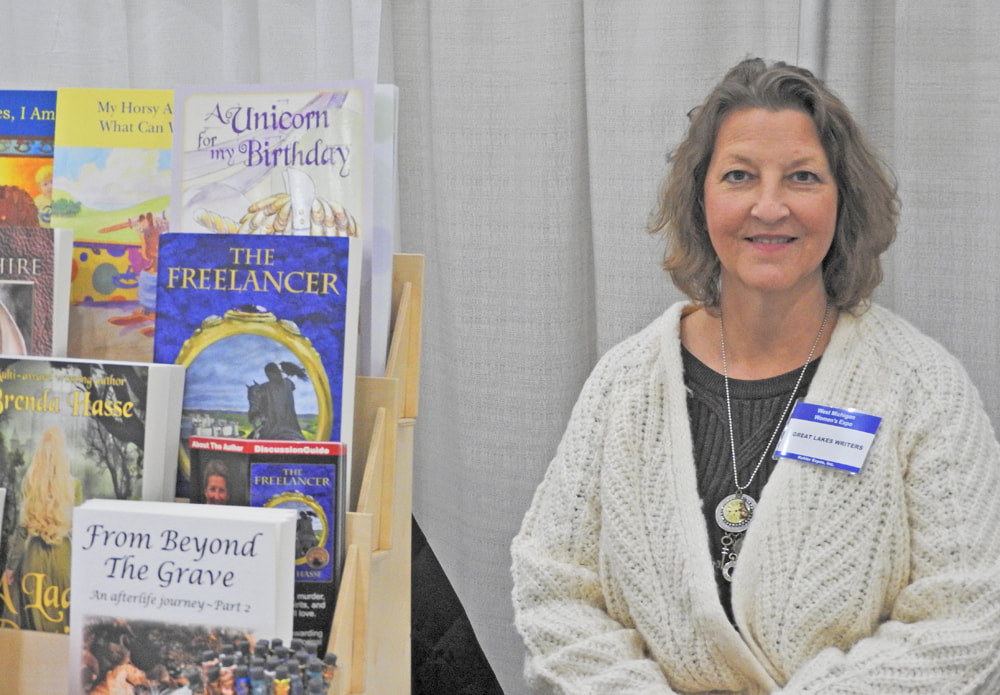
Brenda Hasse
https://brendahassebooks.com/
Brenda is a multi-award-winning author of pre-teen, young adult, and adult novels. She has published several picture books for children as well.
Among her titles: The Freelancer, On The Third Day: An afterlife journey, From Beyond the Grave: An afterlife journey – Part 2, A Lady’s Destiny, The Moment Of Trust, and Wilkinshire
Brenda volunteers her time writing plays for the Fenton Village Players to perform during the Ghost Walk and Historical Cemetery Walk. She also freelances for magazines from the Fenton, Michigan, home she shares with her husband and cats.
Be sure to come back in two weeks to meet more authors at HeartWood Author Expo II.
In my last HeartWood blog post, I ruminated on work spaces and what to call them, and I took you on a tour of mine, henceforth to be known as my studio. I was happy that several readers took me up on my invitation to share photos and thoughts about their own work spaces. Here's what they shared:
Katherine Myers, Crafter, Claremore, Oklahoma
My space, sometimes called the craft room, sometimes the sewing room, is a lot more cluttered than your lovely space. The clutter is really made up of reminders of my crafting journey, from a crewel Beatrix Potter character I did in high school to whatever I’m currently working on. My mother’s old Singer is still the one I use, and a patchwork doll quilt made by my grandmother covers a back up machine. There’s a schoolhouse wall hanging courtesy of my daughter and rugs hooked from recycled wool. Also a spinning wheel I’m determined to use! And yarn, lots of yarn, for knitting. And I can look out the window and see hellebores in bloom right now!
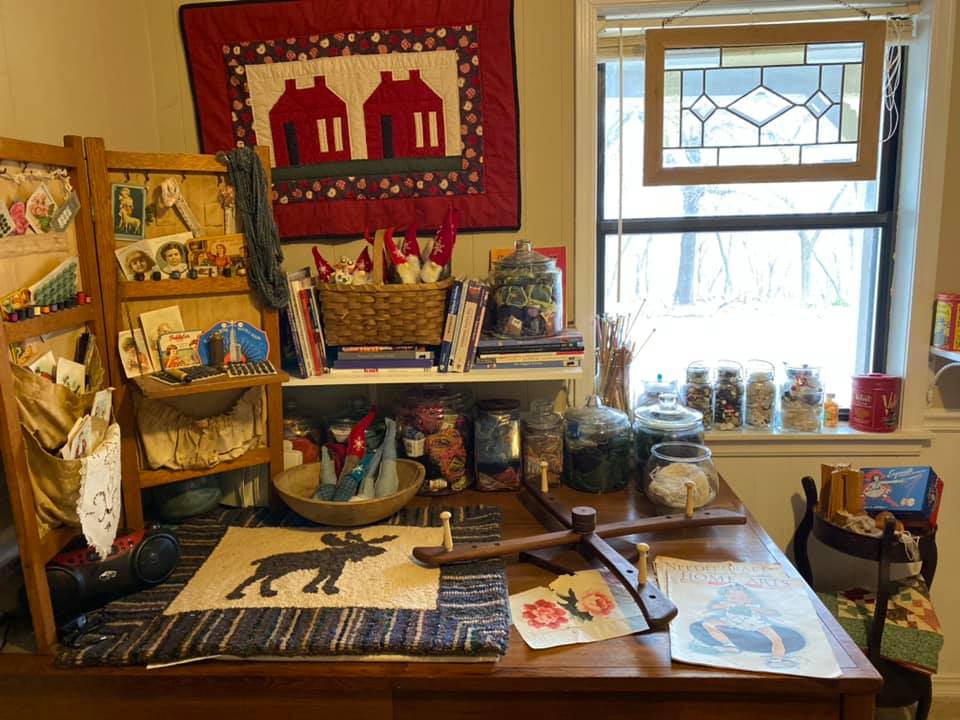
Katherine's craft room reflects her many interests and talents
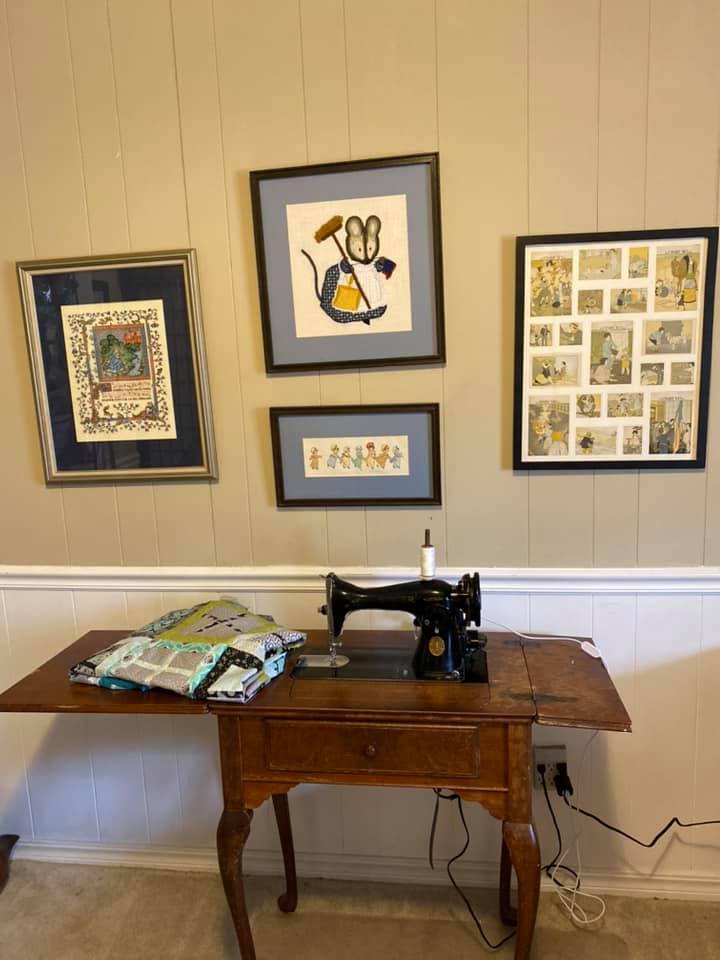
The heirloom Singer
Sandra Bernard, Author and Musician, Newaygo, Michigan
My space is my dining room table, which is piled with papers and books and snacks and Kleenex and CDs and the last 4 days' mail and a box of clean paper for my scribbles. Typing on the computer for my more creative moments just doesn't work--it's an old brain to pen habit.
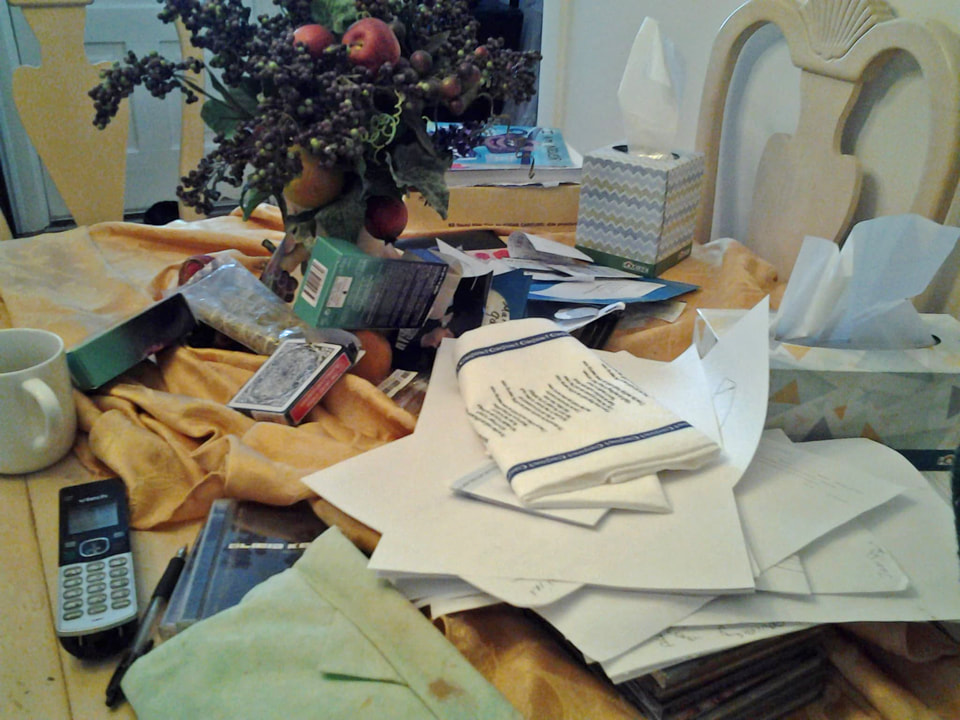
Sandra's creative space
Mark Winston, Professor and Senior Fellow, Centre for Dialogue, Simon Fraser University, Vancouver, BC
(Also one of my grad school office mates)
Oddly, although I have a large office at work and a comfy office at home, most of my writing and meetings these days are at coffee houses! Go figure.
Editor's note: A few years ago, Mark wrote this post for his blog "The Hive" about working in coffee shops: Coffee Culture.
Editor's note: A few years ago, Mark wrote this post for his blog "The Hive" about working in coffee shops: Coffee Culture.
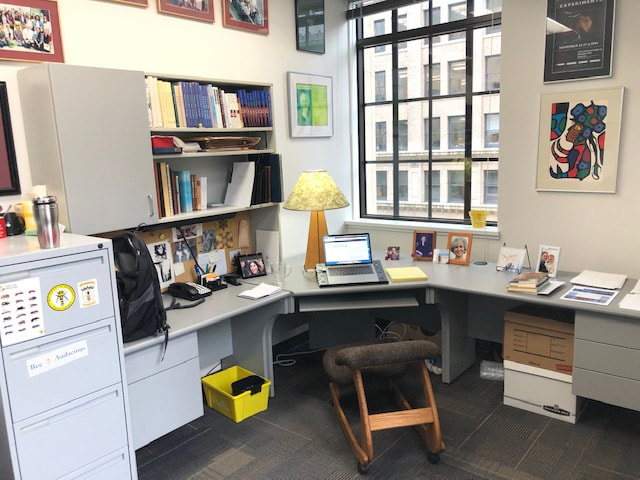
Mark's at-work office at Simon Fraser University
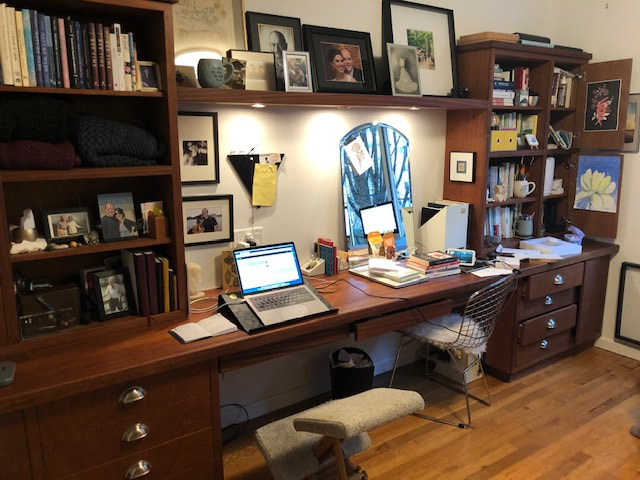
Mark and Lori's home office. Mark says they sometimes send each other emails while working side by side.
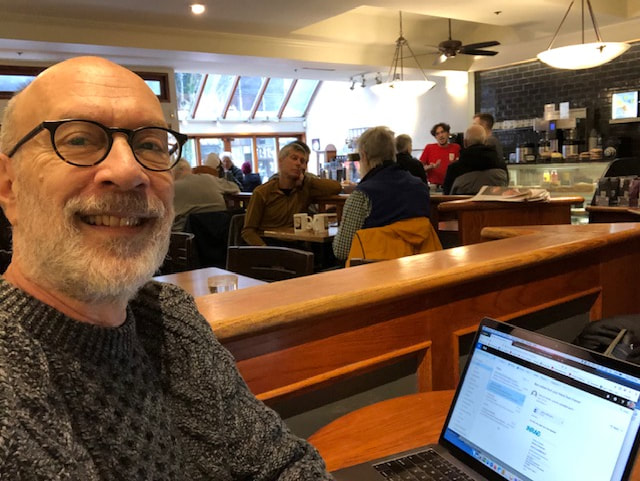
Mark in his coffee-shop workspace
Marsha Traxler Reeves, Holistic Nurse, Newaygo, Michigan
Balanced Blessings
I favor the name "studio" too. I call mine an office, though, because my art is health care and people are accustomed to going to an "office" for that.
My desk, I think, is more jumbled than yours, as there always seems that there is more to do than I have time for. My rocks painted with Anishinaabe designs keep things from getting lost, and inspire me to be a good person. I love my plastic-free water bottle and the basket made of cedar and bulrush by my friend and master weaver, Renee Dillard. The pastel painted plastic skull is something I use to explain to clients what I'm doing, so it always has a place on my desk where it's handy. After all, Craniosacral Therapy is one of my specialties. And the timer is helpful for keeping me safe from the Facebook vortex. At least most of the time.
My desk, I think, is more jumbled than yours, as there always seems that there is more to do than I have time for. My rocks painted with Anishinaabe designs keep things from getting lost, and inspire me to be a good person. I love my plastic-free water bottle and the basket made of cedar and bulrush by my friend and master weaver, Renee Dillard. The pastel painted plastic skull is something I use to explain to clients what I'm doing, so it always has a place on my desk where it's handy. After all, Craniosacral Therapy is one of my specialties. And the timer is helpful for keeping me safe from the Facebook vortex. At least most of the time.
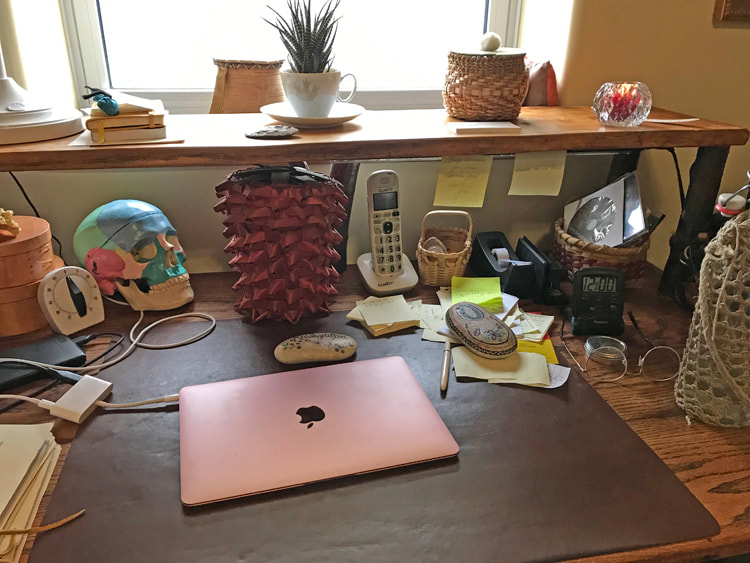
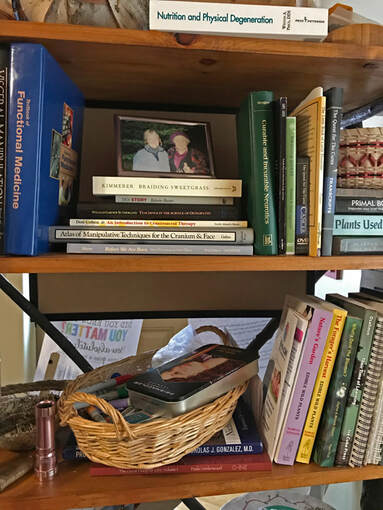
The books in my office are both inspirational and references. And my colored pencils wait for an opportunity to decorate and enhance whatever they can. I actually made the red and black ash basket and am keeping it safe here until the time arrives to give it away. I also love that my shelves and desk are proof that we don't need to process and manufacture to have beautiful and functional items for our lives. They are made from trimmings from cherry orchards and salvaged wood.
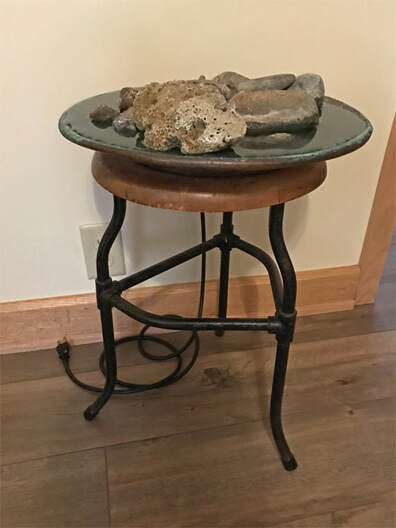
My fountain is made of a big copper dish and rocks that my Grandmother collected along the north shore of Lake Superior in the 1950's. Rockhounds run deep in my family tree.
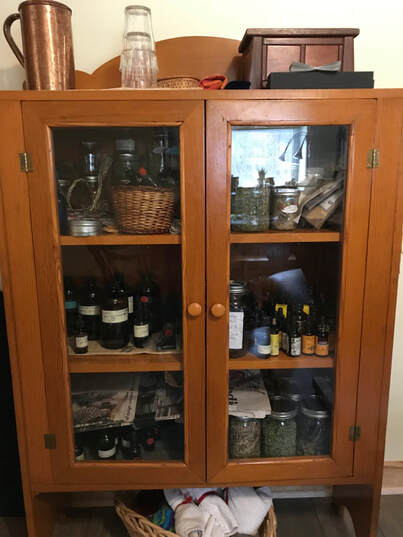
The medicine cupboard, which used to be a pie cupboard, holds most of the medicinals I've gathered and made into tinctures and oils over the last couple of years. I have most of what's needed for the common ailments we encounter, and I love helping people find out that what grows around us can be healing and nourishing as well as beautiful. I keep a water pitcher and glasses on top of the cupboard, and a basket of toys for the littles underneath it.
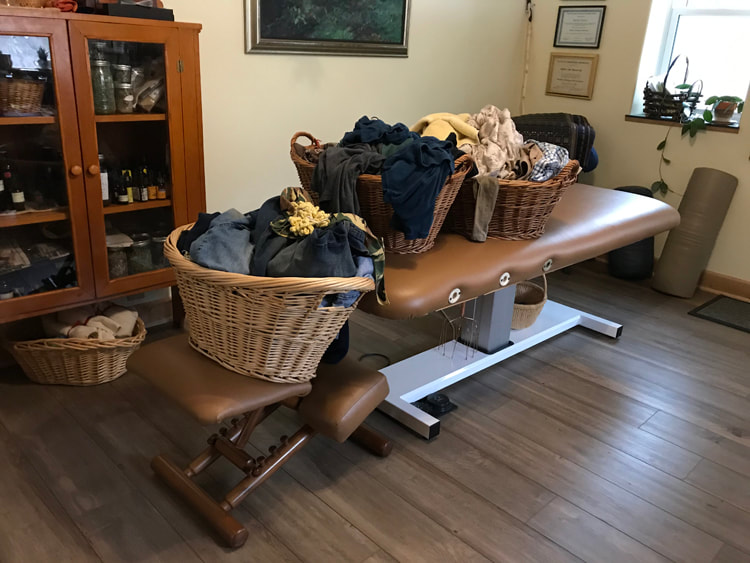
The photo of my office table is proof of the multi-purpose nature of my work space. The electric table adjusts to the perfect height for working on people's necks and backs, as well as for folding laundry. I'm kinda proud that those laundry baskets are about 40 years old and still going strong.
Michelle Celarier, Journalist, Croton on Hudson, New York
My home office, which I've had since 1995, is so full of books and papers that I often prefer to write on my laptop from a comfy chair and ottoman in a sunny corner of my living room, which I've now decided is my desk. (This is also one reason why I only read books on my kindle app on the laptop.) In the summer, I sometimes work from the front porch. That said, we actually have two large rooms in our house that serve as offices and another is a painting studio.
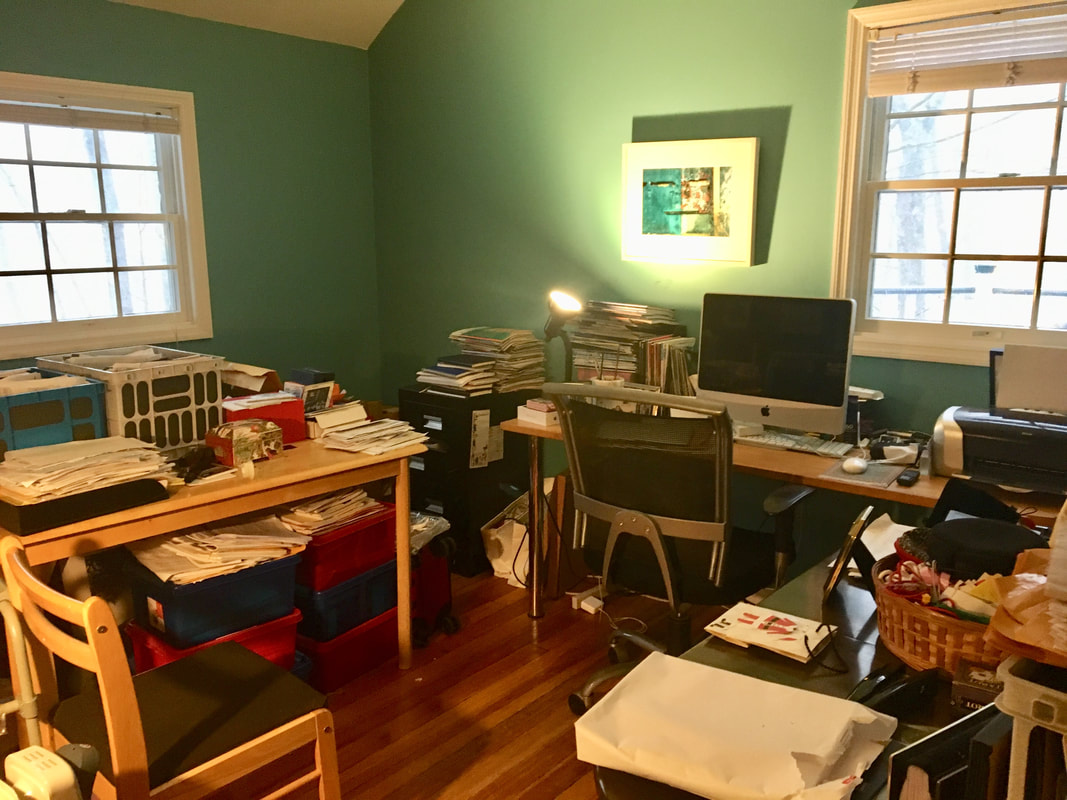
Michelle's office in the home she shares with her husband, artist Taher Shafie (tahershafie.com). The office is outfitted with three tables and walls of books.
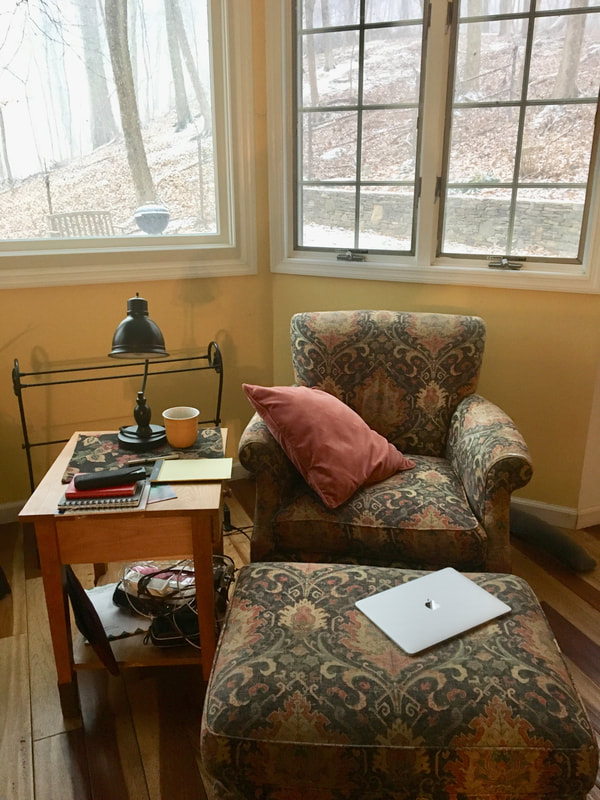
The comfy corner where Michelle prefers to work
Nancy and Ed Waits, Former High School Teachers, Newaygo, Michigan and Bartow, Florida
In Newaygo, we have what originally was called the library, then office, which was meant for both of us. But Ed has pretty much taken it over with his involvement in two organizations that require time on the computer and storage of hard copy documents. I have my sewing room downstairs that is occasionally a guest bedroom.
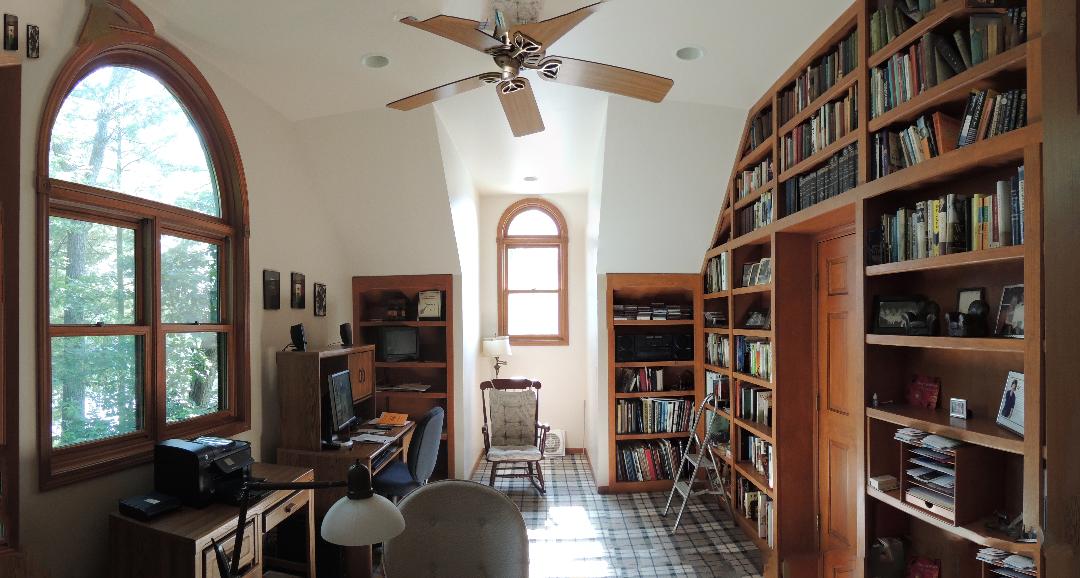
Ed and Nancy's (mostly Ed's) Newaygo home office
In Florida, our Florida room does it all.
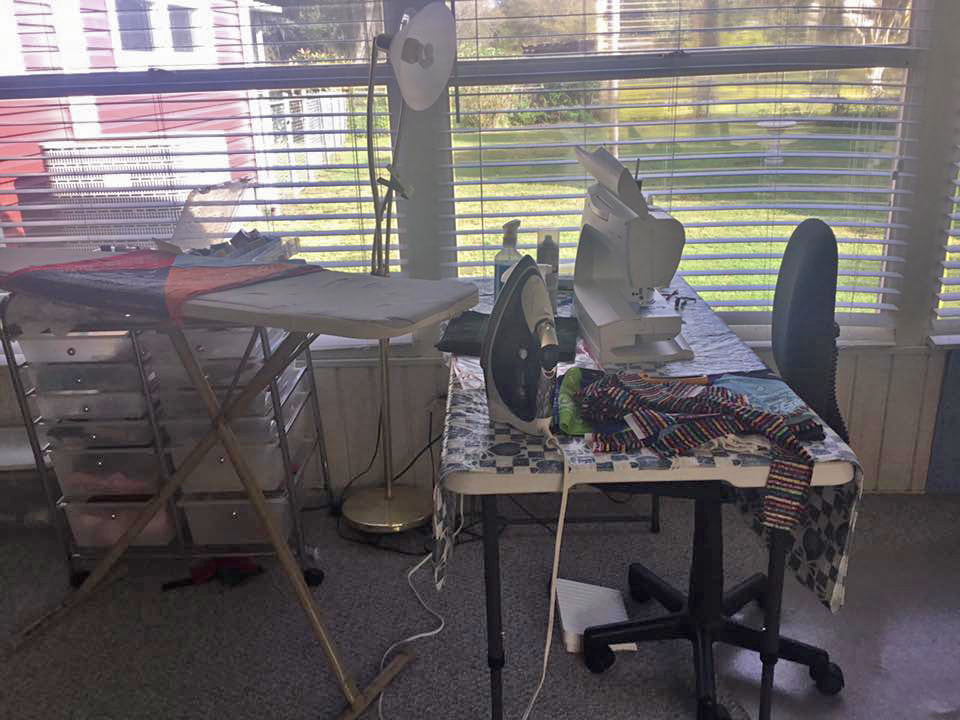
The Florida room in their Florida home
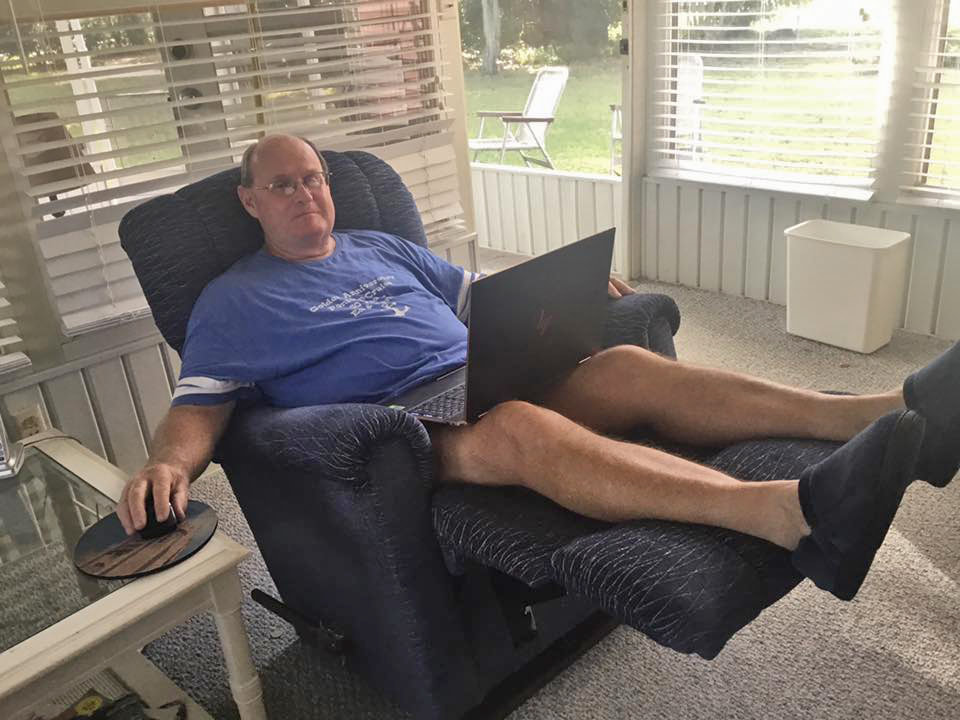
Ed's Florida command post
Sandra McPeak, Investment Advisor, Palos Verdes Peninsula, California
I love the question you posed. It got me thinking how eclectic I am about being creative. I do not really have a dedicated space to create. Thus by default my creative space is in my head when I go jogging. I love running up and down the hills and around twists and turns, noticing the houses as I pass and letting my mind wander wherever it wants to go. It’s led to a few creative epiphanies. Compared to the rest of my life with more structured time and activities. I admire your followers who also make time and a special space for creativity.
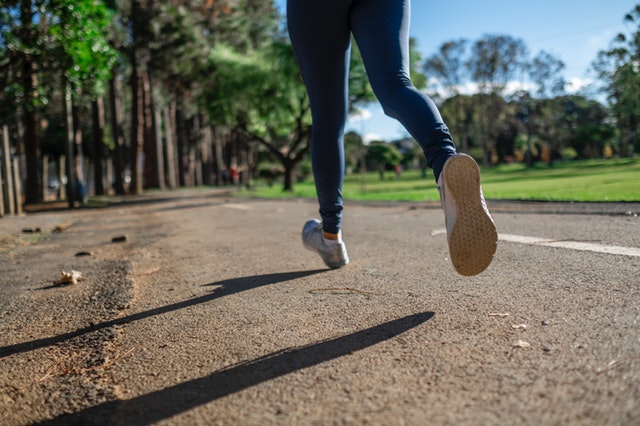
(Photo by Daniel Reche from Pexels)
Sally Wagoner, Earth Lover, Newaygo, Michigan
I can’t think of a known word yet that adequately names the spaces that I do this deep contemplative work in. Both of my areas contain altars, intentional settings that contain items which vibrate with those concentric rings of a kind of consciousness that synchronize with mine, and can take me to those places of which I know you are familiar as well.
One has inks, paints and pencils and a view that opens to the sky, water, a cacophony of native plants and flying things in summer, and gray-white ice in winter. All seasons are eclipsed with the presence of Grandmother Cedar and her Grandson Pine Tree at her side, always receptive to a greeting and prayer. It has a comfy chair as well to sink into, lending itself to deep revelry and thought.
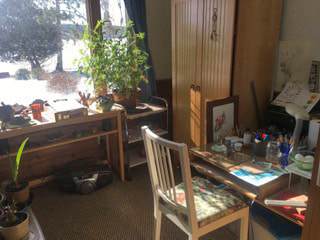
One of Sally's creative spaces
The other space is more cocoonish, but still with an altar of vibrating sacred things and a view that is closer and more woodsy. This space has a bed that I retreat to on sleepless nights that also lends itself well to safety and security while journeying in thoughts or prayers, and when creativity needs to flow to paper or laptop.
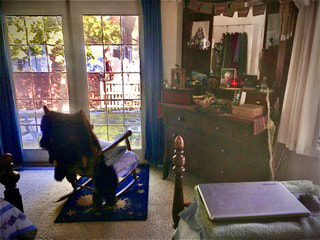
Sally's cocoon
Then there is the “computer room” where household and work related tasks get accomplished in an as-efficient way as possible. But even this space is populated with friends of a non-human nature, and gifts from the hearts of human friends as well. It has functional furniture made by my life partner whose surfaces reflect the spirit of the universe that help rescue me from becoming trapped in brain bytes.
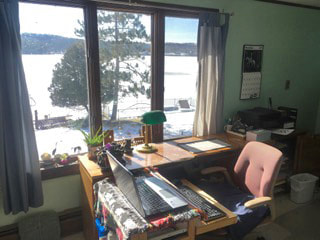
The computer room
I am grateful to have these places, and blessed to have been led to the knowing that these outer spaces are needed so I may reach those inner dimensions, to help keep my life in balance.
J.Q. Rose, Author, Fremont, Michigan and Brooksville, Florida
In Florida, I have a desk (that I share with my hubby). That's a bit larger than what I wrote on when we were full-time RVers: the kitchen table in the RV, and I had to move all my "stuff" into an extra chair in order to eat there.
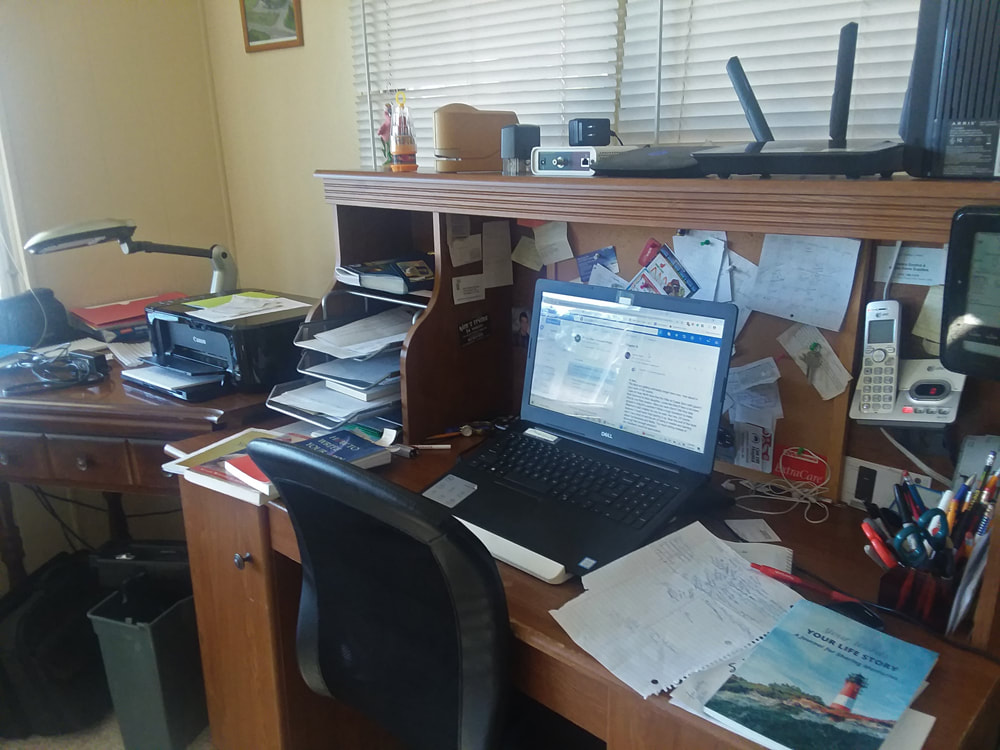
J.Q's Florida work area as it looks when she's in the midst of preparing to present a workshop
At home in Michigan we do have a dedicated room for an office. Yes, office. That's where the files and bookshelves are and of course the desk. The room has dark paneling, the piano and a few framed photos of travels. Not a very bright, inspiring place to write. Maybe that's why I write everywhere in the house--recliner, kitchen counter, dining room table, deck. Yes, much brighter and more space for my laptop and cup of tea.
Do these glimpses of other people's work areas give you ideas for ways to use your own? Are you inspired to carve out a completely different niche for your creative endeavors?
A few weeks ago, Writer’s Digest put out an intriguing invitation to readers: Submit a photo (or two, or three) of your workspace, along with comments on how you use it, why it’s set up the way it is, or anything else you'd like to say about it. The editors will pick a few to publish in the magazine.
I had every intention of submitting mine, but before I managed to assemble the pictures and send off the entry, the deadline had passed. Still, the challenge got me thinking about my own work space, not only how I use it, but also what I call it.
I had every intention of submitting mine, but before I managed to assemble the pictures and send off the entry, the deadline had passed. Still, the challenge got me thinking about my own work space, not only how I use it, but also what I call it.
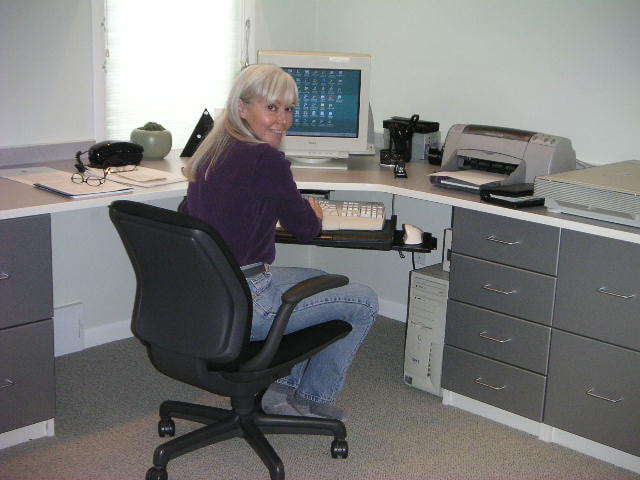 The office in our previous home was functional and definitely office-like
 When I worked from home for my regular job or on freelance assignments, I called my workspace—in our previous home as well as our current one—my “office.” But something about that term grates on me now. It conjures images of deadlines, dingy cubicles, and that sense of being chained to a desk, unable to escape and have fun.

Very conducive to getting stuff done!
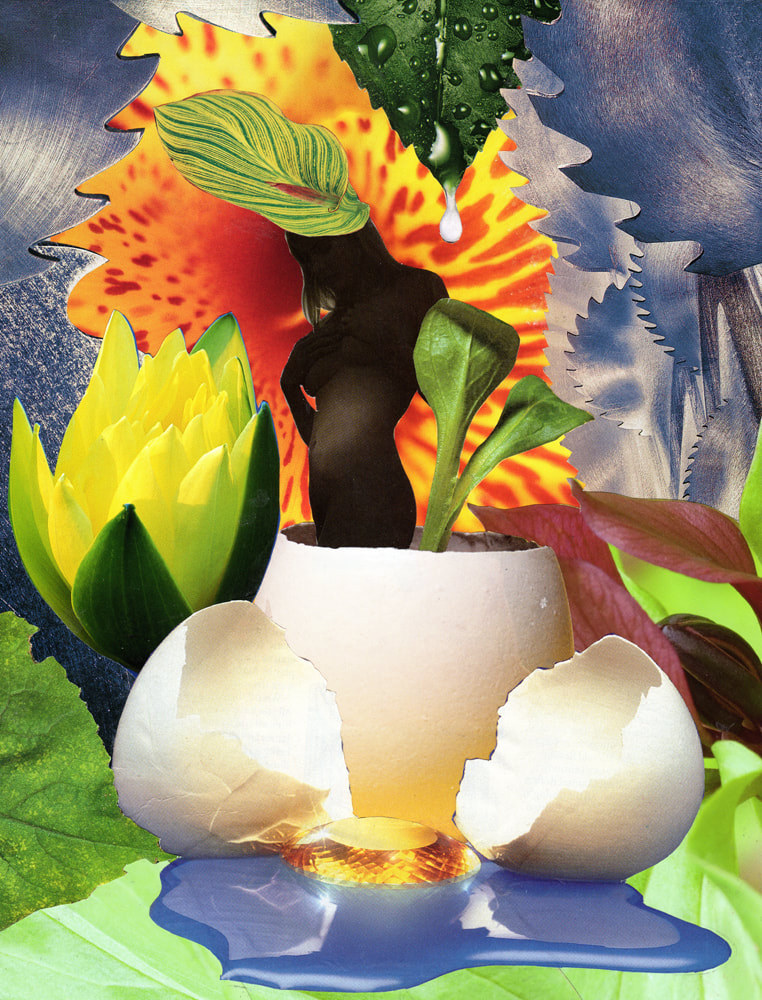 Now, I want a place to play--making collages, for instance--as well as work
 Nowadays, although I still spend a lot of time in the room where my desk resides, I’m not always working in the strict sense of the word. Sometimes I’m practicing yoga. Sometimes I’m brainstorming ideas for writing projects, or organizing and editing photos, or sorting and cutting out pieces for collages, or creating music playlists, or communicating with friends, or yes, writing. It’s as much a playroom as a workspace.
So what to call it?
“Workshop” sounds crafty—a good place to build things. But still a little “worky.”
“Study” is what spaces like mine used to be called before the home-office kick. Filled with books, as my room is, studies were places for contemplation and rumination. I certainly do contemplate and ruminate. Yet “study” sounds so studious. Not playful.
“Workshop” sounds crafty—a good place to build things. But still a little “worky.”
“Study” is what spaces like mine used to be called before the home-office kick. Filled with books, as my room is, studies were places for contemplation and rumination. I certainly do contemplate and ruminate. Yet “study” sounds so studious. Not playful.
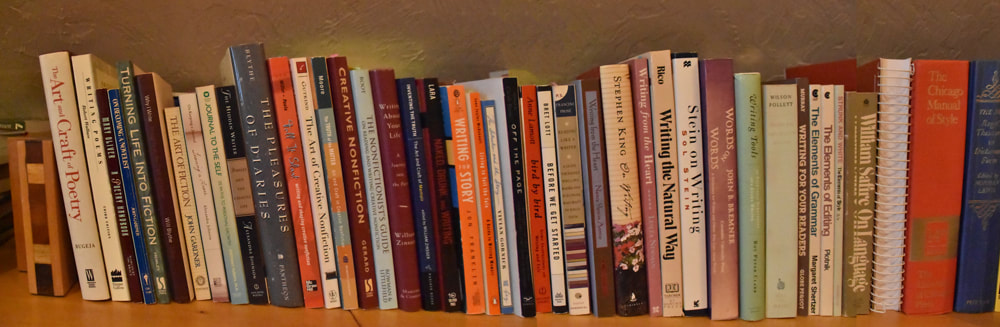
Some of the books I've contemplated in my study--or whatever it's called
I’m partial to “studio.” With its artsy connotations, it leaves open possibilities for all sorts of creative activities. Why, I could even dance in a studio (and sometimes I do!). So for now I’m sticking with studio. And just for fun, I’ll take you on a tour.
Then, I invite you to send me photos of your own creative space and tell me what you call it and how you use it.
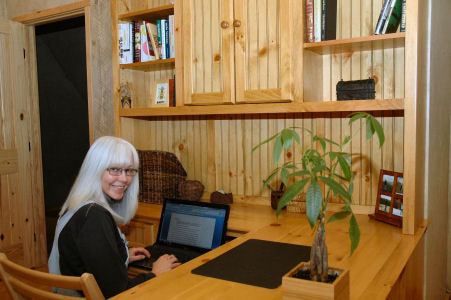
Here's how the workspace in our current home looked when the house was new. Clean desk, clean slate.
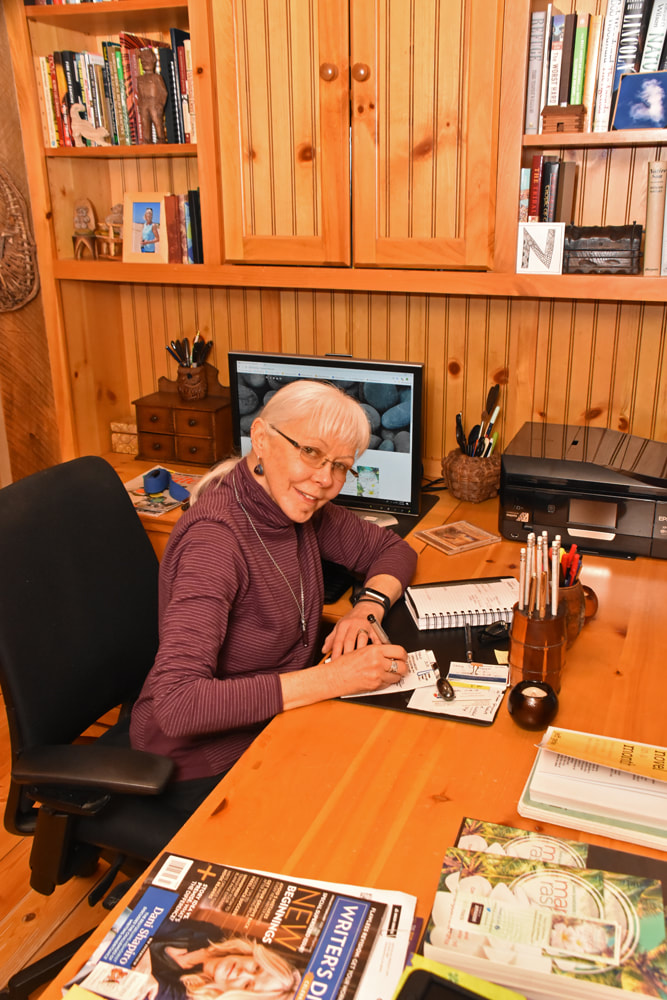
Now, it's more of a happy jumble--a reflection of my usual state of mind. (Photo: Ray Pokerwinski)
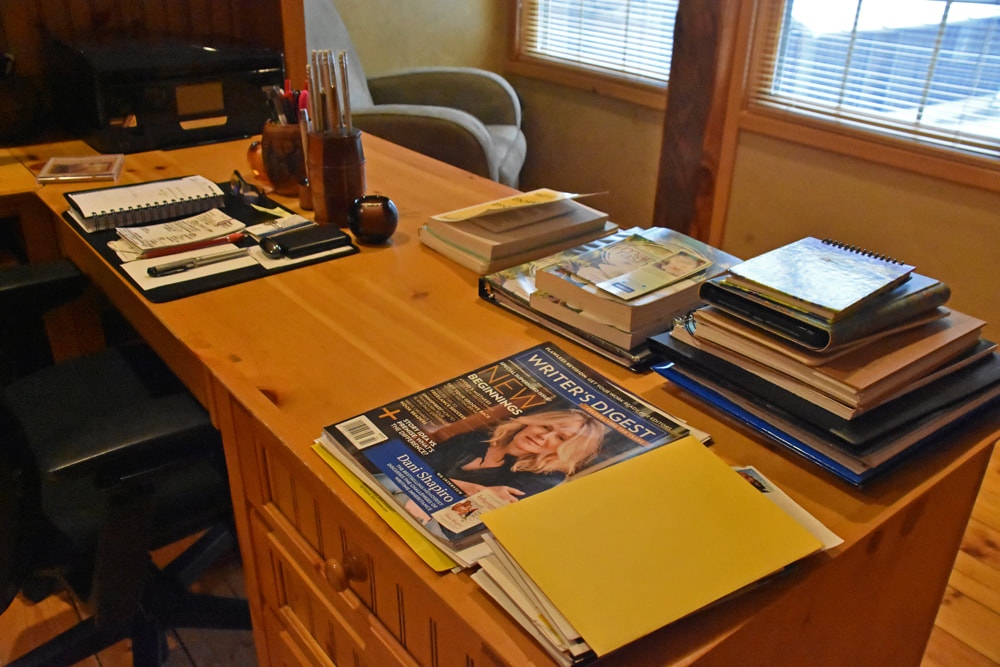
Finished projects, work in progress, and lots of notebooks for ideas and free-writing fill my desktop.
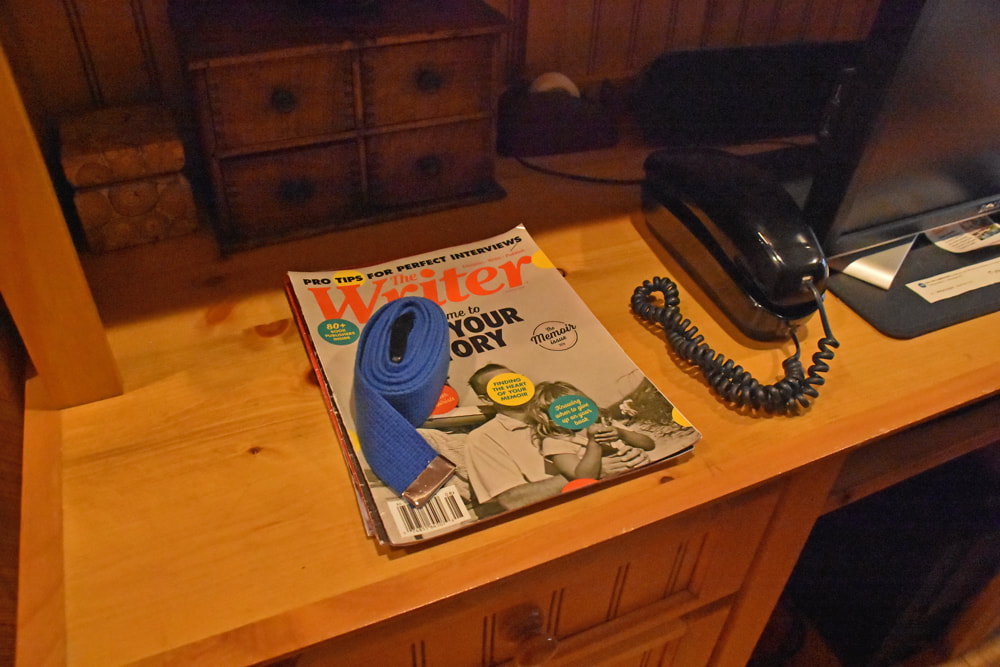
My yoga mat and blocks are stashed in a nearby closet, but I keep a yoga strap handy for impromptu shoulder openers.
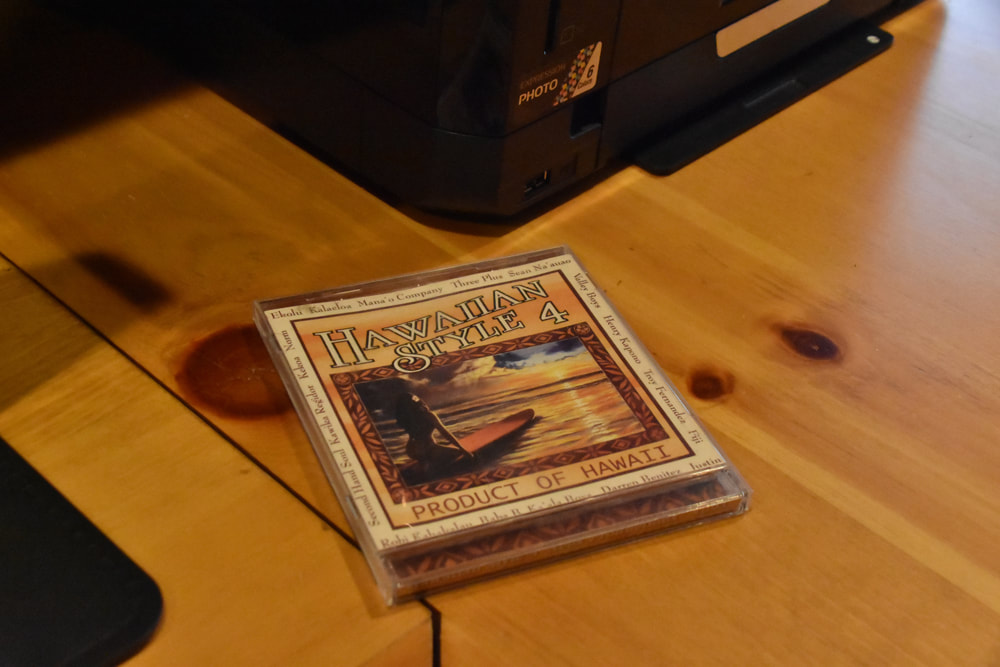
I usually write in silence, but once in a while music helps with inspiration. This CD was a recent gift from one of the major characters in my memoir Mango Rash.
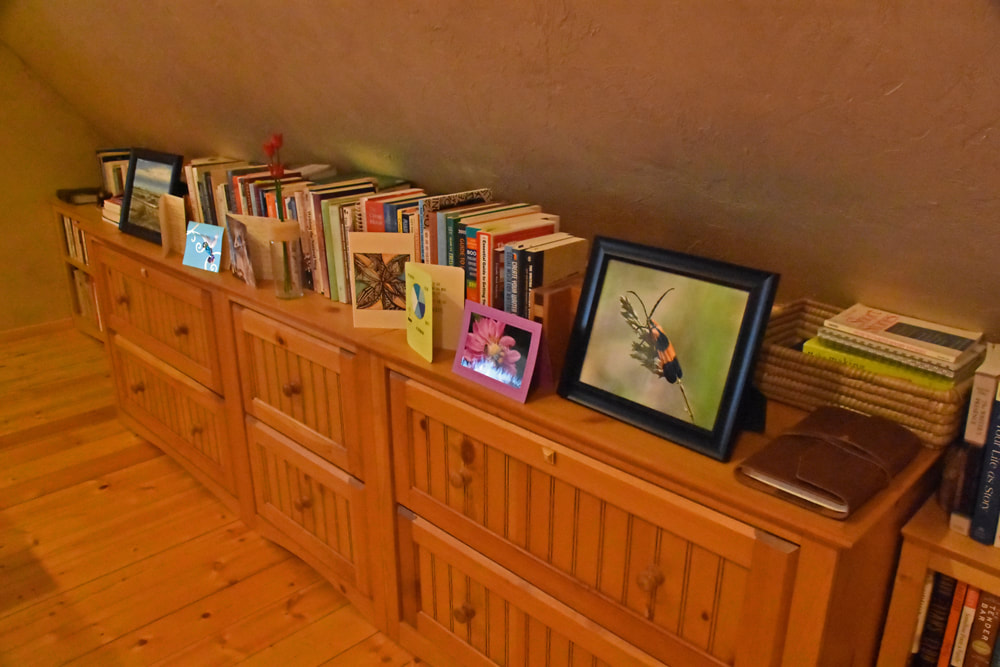
Books, books, books, photos, and cards from friends top the file cabinets.
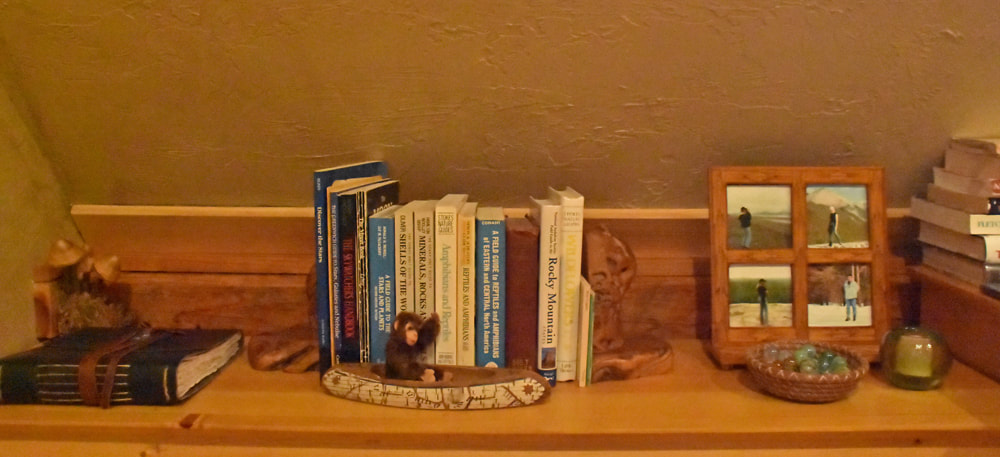
Field guides, childhood treasures, travel photos, and special gifts from friends make me smile.
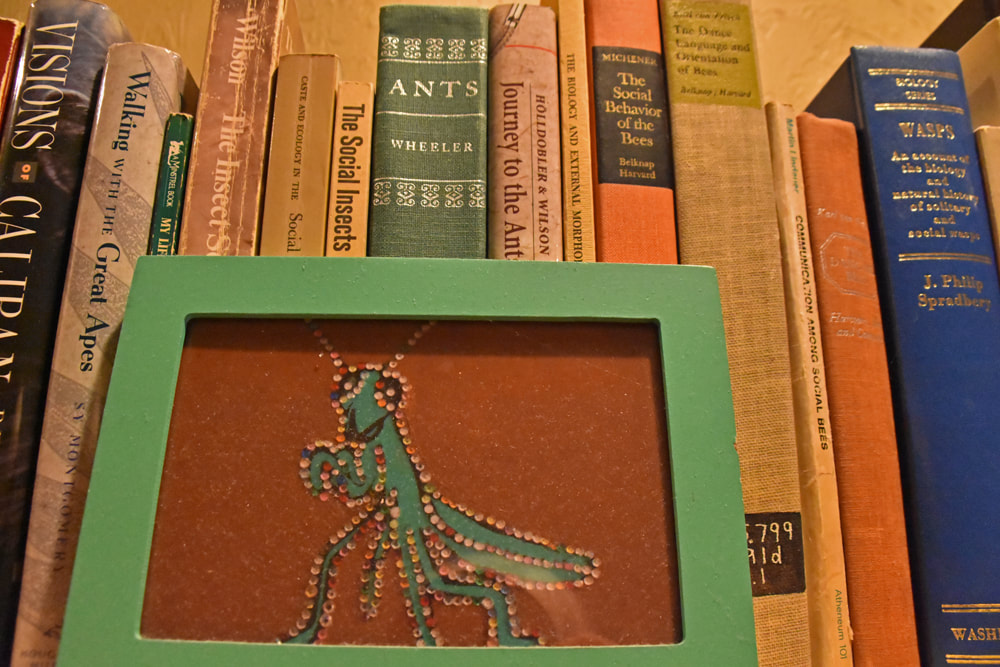
I'm not a book hoarder, honest, but I just can't let go of these reminders of my grad school days. The mantis picture by Claire Fisher seems a perfect complement.
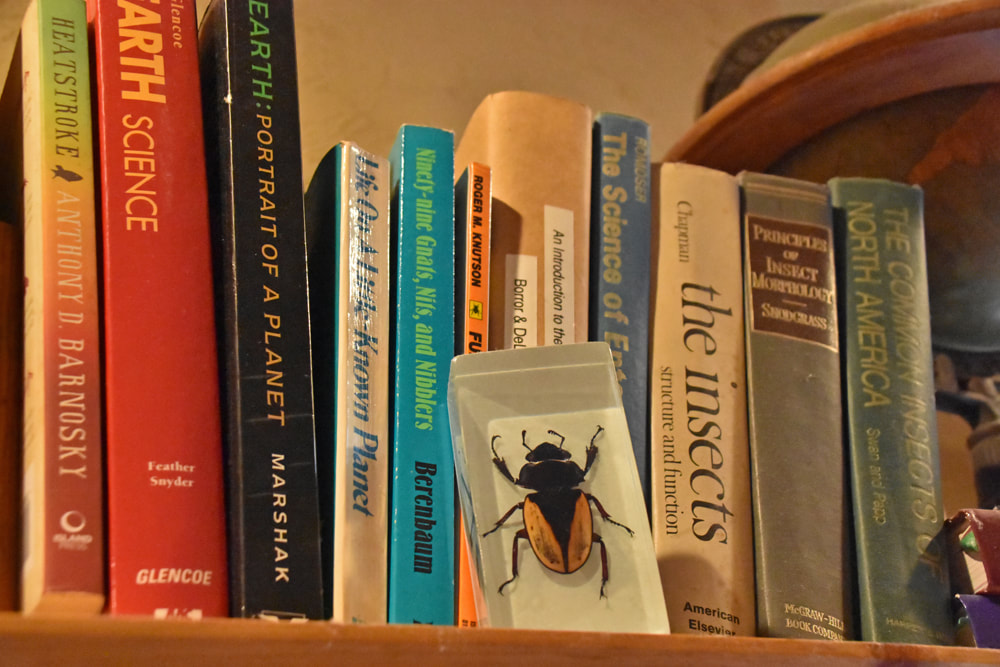
More science stuff, with a buggy treasure from my friend John T.
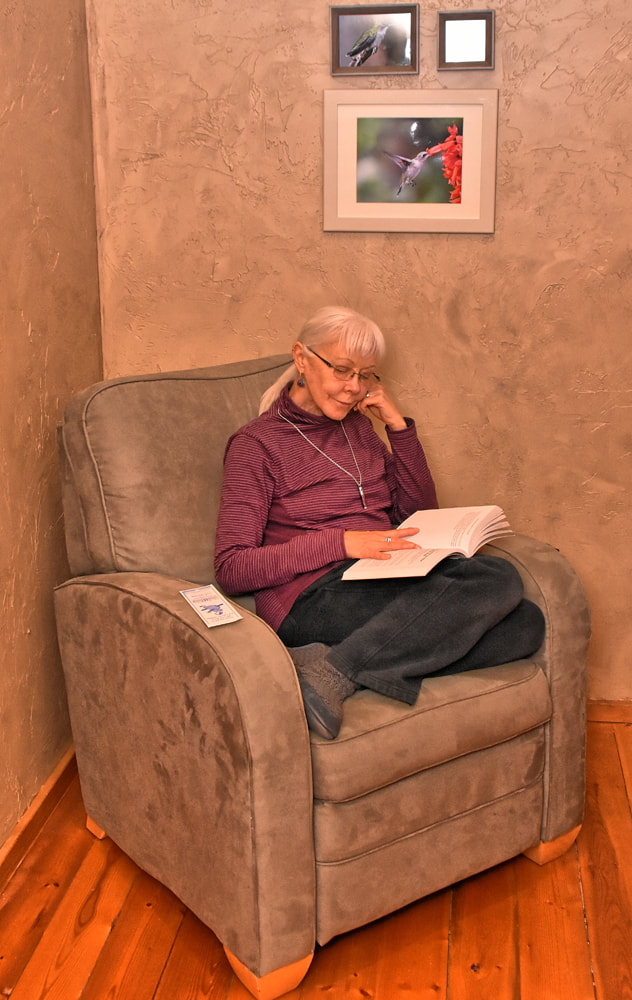 A comfy spot for reading--or daydreaming (Photo: Ray Pokerwinski) | 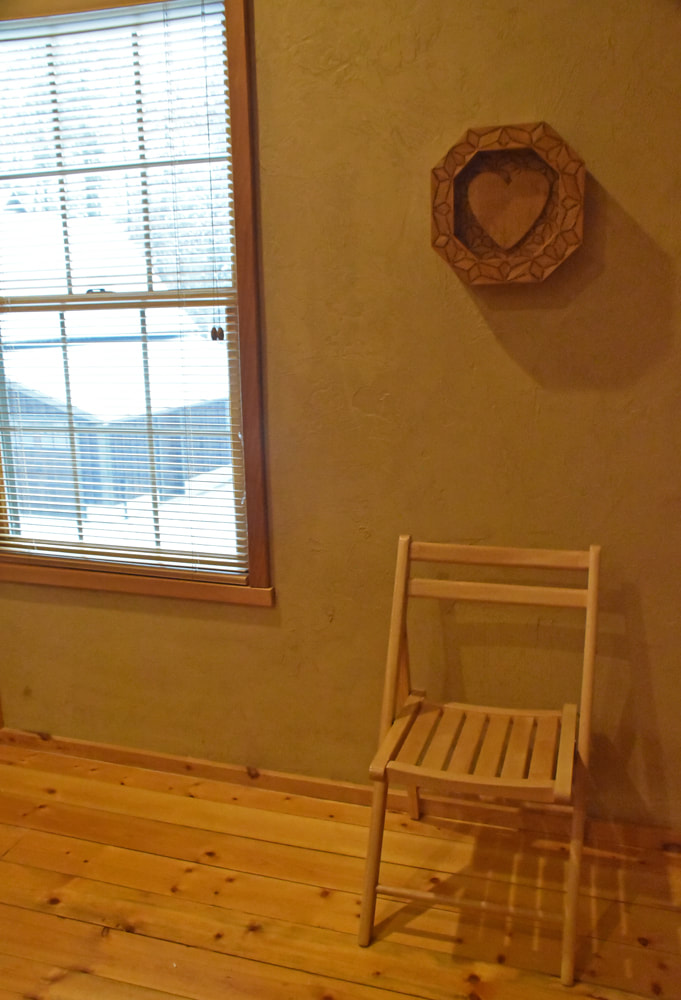 An extra chair for visitors--or chair yoga. Note the HeartWood heart on the wall. |
 A souvenir from a local author event | 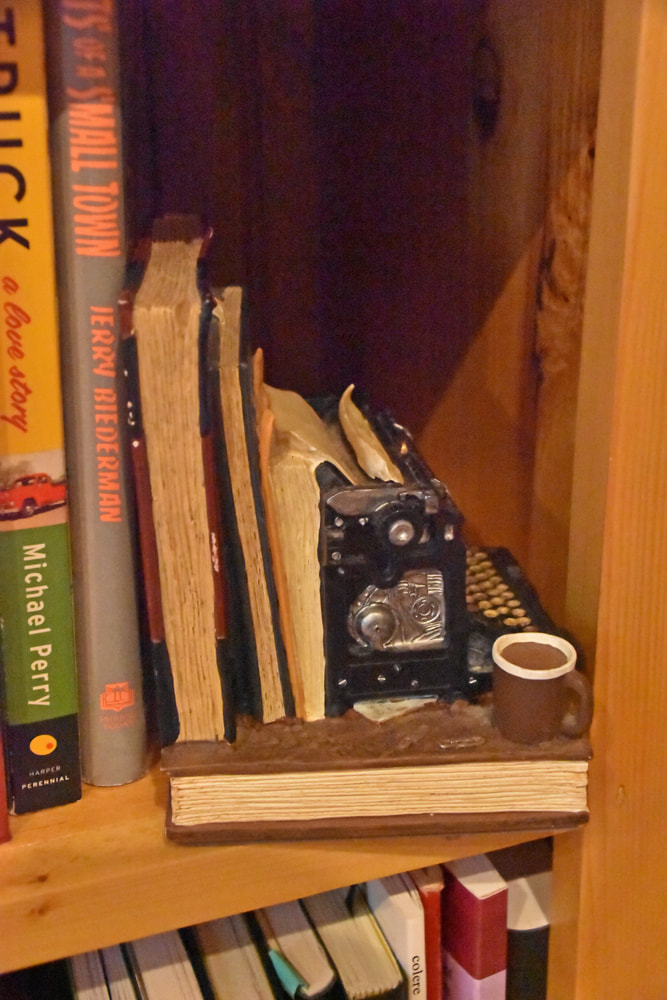 This funky typewriter bookend was a flea market find. |
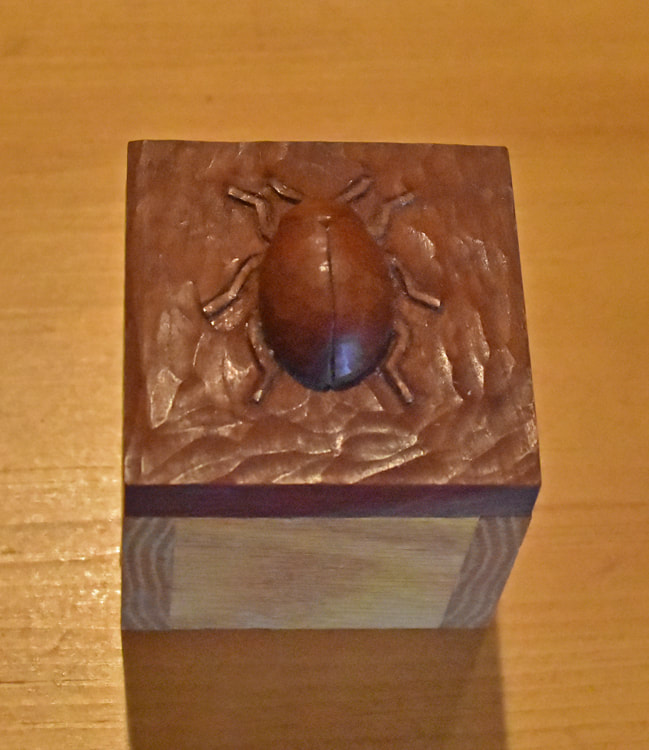 Another buggy treasure from John T holds little doo-dads. | 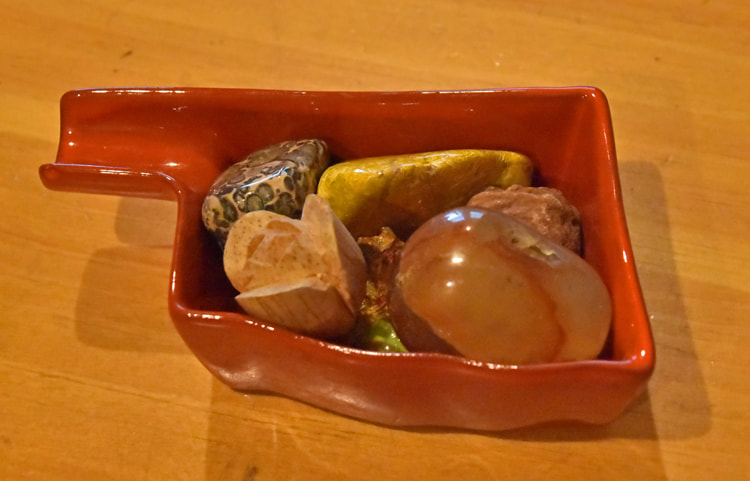 A Frankoma tray in the shape of my home state is the perfect place for special stones and a sandalwood rose. |
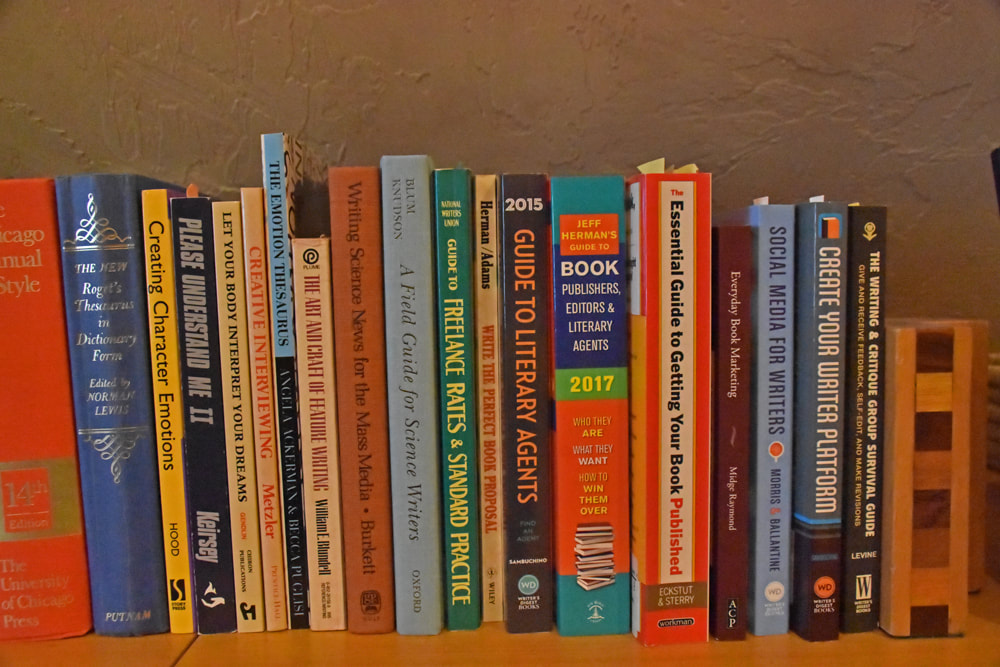
This assortment of books reflects where I've been with my writing . . .
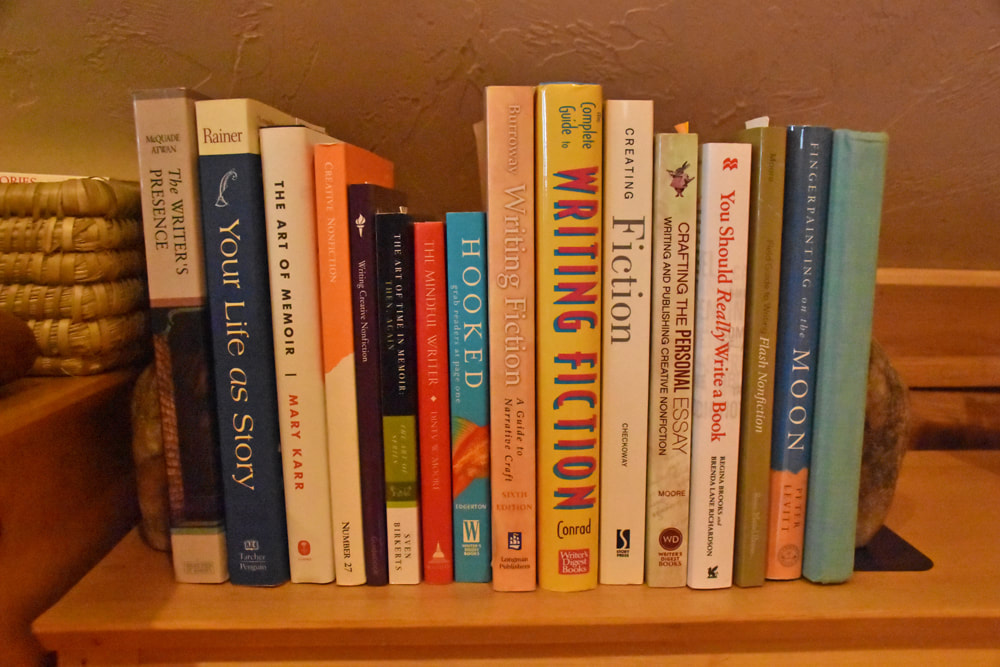
. . . and where I'm going.
Where will your workspace--or playspace--take you?

Happy New Year!
Is today just like any other day for you, or do you see the beginning of a new year as a time to reflect and set intentions?
As I wrote here a year ago, I no longer make formal resolutions or long lists of goals and aspirations for the coming year. Still, the idea of a fresh start is so appealing I can't resist trying to do a few things differently.
Or maybe just one thing. This time last year, I vowed to break the habit of starting my day by checking my inbox and scanning headlines. Too often, that practice left me agitated and unfocused--exactly not the way I want to be when I sit down to write or tackle other tasks that require concentration.
Is today just like any other day for you, or do you see the beginning of a new year as a time to reflect and set intentions?
As I wrote here a year ago, I no longer make formal resolutions or long lists of goals and aspirations for the coming year. Still, the idea of a fresh start is so appealing I can't resist trying to do a few things differently.
Or maybe just one thing. This time last year, I vowed to break the habit of starting my day by checking my inbox and scanning headlines. Too often, that practice left me agitated and unfocused--exactly not the way I want to be when I sit down to write or tackle other tasks that require concentration.

It was a worthy goal, one I tried all year to accomplish. But the busy-ness of book publishing and promotion and the enticement of never-a-dull-moment national news was too seductive. I just couldn't keep myself from going online before breakfast.
Until a few weeks ago, when I finally found the mettle to break the habit. What flipped the switch for me was a piece by Colleen Story on her Writing and Wellness website that caught my attention with the subhead, "Why Writers Should Avoid the Internet First Thing in the Morning."
In the article, Colleen cites research suggesting that hopping around on the internet interferes with the ability to focus even after getting offline. She goes on to list five first-thing-in-the-morning activities that are more conducive to all-day productivity. I won't repeat the list here--you can read the full article for that.
Until a few weeks ago, when I finally found the mettle to break the habit. What flipped the switch for me was a piece by Colleen Story on her Writing and Wellness website that caught my attention with the subhead, "Why Writers Should Avoid the Internet First Thing in the Morning."
In the article, Colleen cites research suggesting that hopping around on the internet interferes with the ability to focus even after getting offline. She goes on to list five first-thing-in-the-morning activities that are more conducive to all-day productivity. I won't repeat the list here--you can read the full article for that.
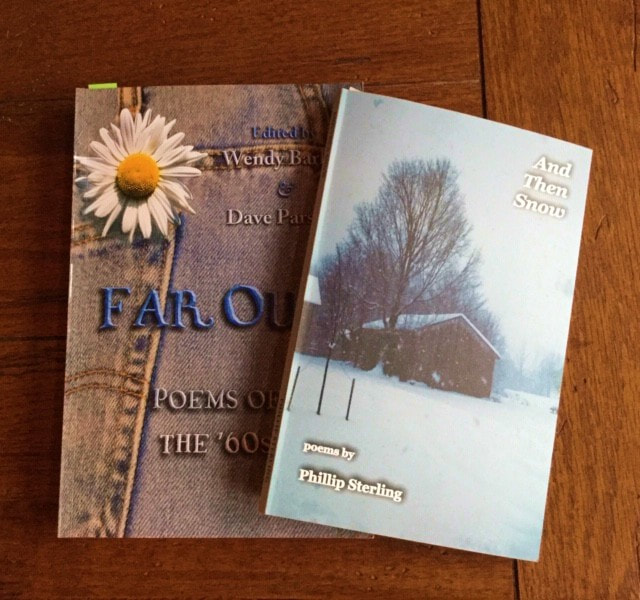 Two poetry books I'm reading this week
 But I will tell you about the change I've made. For the past three weeks this has been my morning routine: yoga, reading poetry, writing down dreams or other thoughts (but not to-do lists), then working on my novel-in-progress. Email and other online business come only after all of that.
I was astonished at how quickly changing that one habit made a difference in my mindset. As I wrote in my journal after just a few mornings of the new routine, "Ideas flow, I feel calmer, less focused on my to-do list; I think instead about what I'm reading and writing. This is good."
In short, simply by changing one habit I feel recharged and ready to put my creativity to work in whole new ways in a whole new year.
I was astonished at how quickly changing that one habit made a difference in my mindset. As I wrote in my journal after just a few mornings of the new routine, "Ideas flow, I feel calmer, less focused on my to-do list; I think instead about what I'm reading and writing. This is good."
In short, simply by changing one habit I feel recharged and ready to put my creativity to work in whole new ways in a whole new year.
Do you have a habit you'd like to change? Need a little help making it happen?
Here are some suggestions I've gleaned over the years:
Here are some suggestions I've gleaned over the years:
- Be clear about why you want to make the change. What desirable thing will it allow you to do or feel?
- Make a plan. List no more than five small steps that will move you toward your goal. If you're giving up a habit, decide what you'll substitute in its place. Think about when, where, and how you'll do the new thing. Picture yourself carrying out your plan.
- Anticipate obstacles that may interfere with making the change. Think ahead about how to deal with them
- Share your intention with someone who supports you, even if that's only yourself in your journal.
- Celebrate every small success. They'll add up to bigger ones.
May 2020 be a year of creativity, connection, and contentment for us all!
In keeping with my December tradition, I've compiled a year-end list of memorable books I've read over the past twelve months. I don't rank my selections, concurring on that point with author Neil Gaiman, who believes picking five favorite books is like "picking the five body parts you'd most like not to lose."
Instead, I list books I've found memorable for any of a number of reasons: the writing is exceptional, the story is engrossing, the tale is told in an unusual way, or the book just stayed with me for reasons I can't explain. The books that make the list aren't the only good books I've read over the course of the year; several others always stand out in memory. My decision of which to include here is arbitrary, but I try to pick ones I think HeartWood readers may also enjoy.
The books listed here weren't all published in the past year. One has a publication date of 2009; the others were all published in the past six years.
I never set out to read books that conform to particular themes, but when I look back at what I've read, I do notice common threads. A number of these books are testaments to perseverance and the ability to overcome adversity, from physical injury to neglect to dysfunction and abuse. Sounds like heavy stuff, I know, but I found all of these books inspiring in one way or another.
I never set out to read books that conform to particular themes, but when I look back at what I've read, I do notice common threads. A number of these books are testaments to perseverance and the ability to overcome adversity, from physical injury to neglect to dysfunction and abuse. Sounds like heavy stuff, I know, but I found all of these books inspiring in one way or another.
Just as I wrote this time last year and the year before, I'm not really sure what to call this list. My Most Want-to-Tell-You-About-Them Books of 2019? Or simply A Bunch of Books I Read This Year and Actually Remember Something About?
Whatever you want to call it, here it is:
Ten Something-or-Other Books I Read in 2019
(in the order in which I read them)
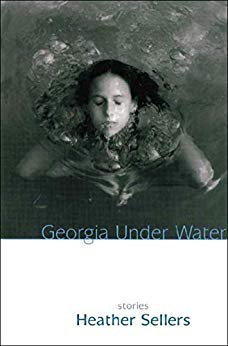
Georgia Under Water: Stories by Heather Sellers
Anytime I see Heather Sellers's byline on an essay or short story in The Sun magazine or elsewhere, I put that piece of writing at the top of my to-read pile. Her honesty and clarity in writing about her unconventional upbringing and life challenges make for riveting stories. The short stories in this collection are fiction, but the protagonist seems to have a lot in common with real-life Heather in her youth. The stories are strange and edgy, yet utterly believable. Especially masterful: Sellers's depiction of the physicality of puberty -- a young girl's startling growth spurts and awkward grace.
Anytime I see Heather Sellers's byline on an essay or short story in The Sun magazine or elsewhere, I put that piece of writing at the top of my to-read pile. Her honesty and clarity in writing about her unconventional upbringing and life challenges make for riveting stories. The short stories in this collection are fiction, but the protagonist seems to have a lot in common with real-life Heather in her youth. The stories are strange and edgy, yet utterly believable. Especially masterful: Sellers's depiction of the physicality of puberty -- a young girl's startling growth spurts and awkward grace.
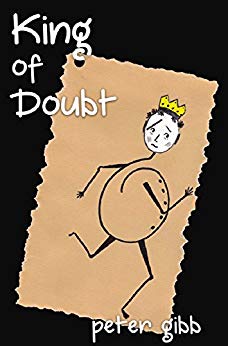
King of Doubt by Peter Gibb
HeartWood readers may remember Peter from his guest post on mindful conversation. King of Doubt will introduce you to younger versions of Peter on his journey from self-doubt to wonder and joy. There are laugh-out-loud moments (young boys discussing how babies are made) and flat-out gorgeous and evocative passages (one in particular in a section about a Ferris wheel). Though Peter's story ventures into darkness, it emerges into hope, and it left me feeling uplifted.
HeartWood readers may remember Peter from his guest post on mindful conversation. King of Doubt will introduce you to younger versions of Peter on his journey from self-doubt to wonder and joy. There are laugh-out-loud moments (young boys discussing how babies are made) and flat-out gorgeous and evocative passages (one in particular in a section about a Ferris wheel). Though Peter's story ventures into darkness, it emerges into hope, and it left me feeling uplifted.
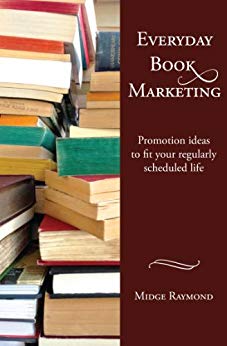
Everyday Book Marketing: Promotion ideas to fit your regularly scheduled life by Midge Raymond
This one's pure practicality. I include it for any other authors or aspiring authors looking for guidance on book promotion. As I mentioned in a previous blog post, the transition from writer to author to book promoter is not a natural one for most of us. This book offers tips on what to do before publication, as well as during and after book launch. Best of all, the emphasis is on keeping the seemingly endless tasks manageable. In addition to Raymond's advice, the book includes Q&As with authors and other experts -- event coordinators, a publicist, a librarian -- who offer additional helpful suggestions.
This one's pure practicality. I include it for any other authors or aspiring authors looking for guidance on book promotion. As I mentioned in a previous blog post, the transition from writer to author to book promoter is not a natural one for most of us. This book offers tips on what to do before publication, as well as during and after book launch. Best of all, the emphasis is on keeping the seemingly endless tasks manageable. In addition to Raymond's advice, the book includes Q&As with authors and other experts -- event coordinators, a publicist, a librarian -- who offer additional helpful suggestions.
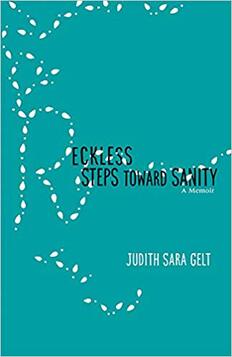
Reckless Steps Toward Sanity A Memoir by Judith Sara Gelt
Full disclosure: Judith is a friend. We met at a writers' conference in 2013, discovered we were at about the same point in writing our memoirs, and kept in touch during the process of drafting, revising, and publishing our books. However, I'm not including her book here simply because she's a friend. It truly is a standout in my mind. As I wrote in my Goodreads review: "With a mother incapacitated by bipolar disorder; a remote, controlling, inappropriately-behaving father; and inaccessible older siblings, Judith Sara Gelt must find her own way in the world. It’s no wonder she takes wrong turns and winds up in some dark and dangerous places. In this honest, unflinching memoir, Gelt takes readers right into those places to witness at close range the choices she comes to regret — and to understand why there are some she never will. Though often disturbing, this girl-to-woman’s story is, in the end, inspiring. Readers will find hope in Gelt’s ability to emerge from her painful past whole and capable of great tenderness."
Full disclosure: Judith is a friend. We met at a writers' conference in 2013, discovered we were at about the same point in writing our memoirs, and kept in touch during the process of drafting, revising, and publishing our books. However, I'm not including her book here simply because she's a friend. It truly is a standout in my mind. As I wrote in my Goodreads review: "With a mother incapacitated by bipolar disorder; a remote, controlling, inappropriately-behaving father; and inaccessible older siblings, Judith Sara Gelt must find her own way in the world. It’s no wonder she takes wrong turns and winds up in some dark and dangerous places. In this honest, unflinching memoir, Gelt takes readers right into those places to witness at close range the choices she comes to regret — and to understand why there are some she never will. Though often disturbing, this girl-to-woman’s story is, in the end, inspiring. Readers will find hope in Gelt’s ability to emerge from her painful past whole and capable of great tenderness."
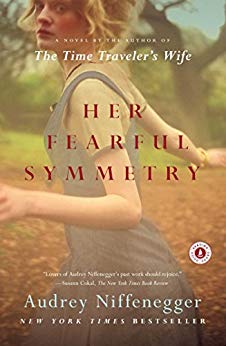
Her Fearful Symmetry by Audrey Niffenegger
If you'd asked me a couple of years ago if I'd like to read a book about a cemetery populated by ghosts, I'd have said, "Ummm, not really." Yet I'm here to tell you I have read -- and enjoyed -- not one, but two such books. The first was George Saunders's Lincoln in the Bardo, which I included on my 2018 year-end book list. This year, it's Niffenegger's compelling tale set in London's Highgate Cemetery. Though reviews from other readers and critics are mixed -- some feeling this work falls short of Niffenegger's The Time Traveler's Wife -- I found it imaginative, quirky, and artful.
If you'd asked me a couple of years ago if I'd like to read a book about a cemetery populated by ghosts, I'd have said, "Ummm, not really." Yet I'm here to tell you I have read -- and enjoyed -- not one, but two such books. The first was George Saunders's Lincoln in the Bardo, which I included on my 2018 year-end book list. This year, it's Niffenegger's compelling tale set in London's Highgate Cemetery. Though reviews from other readers and critics are mixed -- some feeling this work falls short of Niffenegger's The Time Traveler's Wife -- I found it imaginative, quirky, and artful.
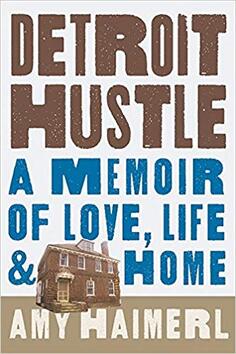
Detroit Hustle: A Memoir of Life, Love, and Home by Amy Haimerl
I'll read just about any book about Detroit, yet not all end up on my most-memorable list. This one was an un-put-downable delight. Transplanted Brooklynites Haimerl and her husband sink their savings -- and a lot more -- into an abandoned 1914 Georgian Revival house. Detroit Hustle is the story of a house that becomes a home (though not easily or cheaply), a city in transition, and most of all, a sense of place and belonging.
I'll read just about any book about Detroit, yet not all end up on my most-memorable list. This one was an un-put-downable delight. Transplanted Brooklynites Haimerl and her husband sink their savings -- and a lot more -- into an abandoned 1914 Georgian Revival house. Detroit Hustle is the story of a house that becomes a home (though not easily or cheaply), a city in transition, and most of all, a sense of place and belonging.
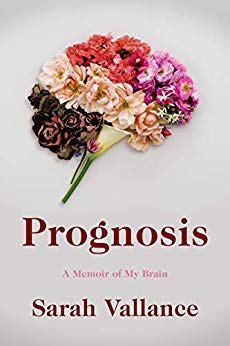
Prognosis: A Memoir of My Brain by Sarah Vallance
Thrown from a horse, Vallance, a PhD with a high-level career, suffers a traumatic brain injury that causes her IQ to plummet and her personality to change. At first, she accepts the dire prognosis she's given, believing there's no hope of recovery. Fortunately, she eventually rejects that view and begins rehabilitating herself. Her memoir is a remarkable story of perseverance.
Thrown from a horse, Vallance, a PhD with a high-level career, suffers a traumatic brain injury that causes her IQ to plummet and her personality to change. At first, she accepts the dire prognosis she's given, believing there's no hope of recovery. Fortunately, she eventually rejects that view and begins rehabilitating herself. Her memoir is a remarkable story of perseverance.
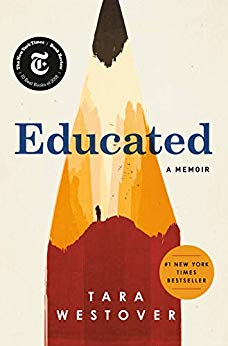
Educated: A Memoir by Tara Westover
A New York Times bestseller, one of President Obama's favorite books of 2018, praised by Bill Gates and just about every reviewer in the universe, this book hardly needs my endorsement. But here it is anyway. Raised in a survivalist, fanatically religous family that mistrusts formal education, yet provides little in the way of home schooling, Westover somehow manages to extricate herself and make up for the astonishing gaps in her knowledge of life and the world we live in. This story bears witness to the power of learning.
A New York Times bestseller, one of President Obama's favorite books of 2018, praised by Bill Gates and just about every reviewer in the universe, this book hardly needs my endorsement. But here it is anyway. Raised in a survivalist, fanatically religous family that mistrusts formal education, yet provides little in the way of home schooling, Westover somehow manages to extricate herself and make up for the astonishing gaps in her knowledge of life and the world we live in. This story bears witness to the power of learning.
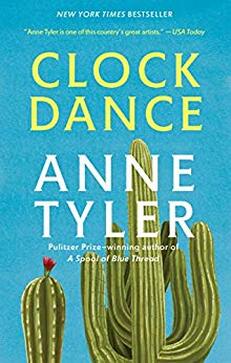
Clock Dance by Anne Tyler
You didn't think I could leave Anne Tyler out of a memorable-books roundup, did you? Her latest novel, published last year, is delightfully quirky in that inimitable Anne Tyler way. With a cast of offbeat, yet convincing characters and a compelling tale of self discovery that spans fifty years, this is a dance I just couldn't sit out.
You didn't think I could leave Anne Tyler out of a memorable-books roundup, did you? Her latest novel, published last year, is delightfully quirky in that inimitable Anne Tyler way. With a cast of offbeat, yet convincing characters and a compelling tale of self discovery that spans fifty years, this is a dance I just couldn't sit out.
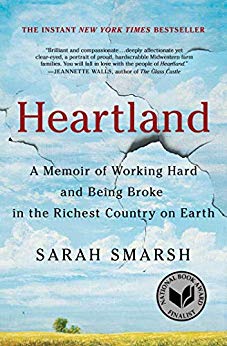
Heartland: A Memoir of Working Hard and Being Broke in the Richest Country on Earth by Sarah Smarsh
The title neatly sums up Smarsh's story, but there's so much more to this widely-acclaimed best-seller. It's at once a deeply personal story and a sociological treatise on the plight of America's rural poor and the complex mix of factors that keep them stuck in cycles of poverty. I'm descended from hard-working, rural folks like Smarsh's family, yet her book opened my eyes to aspects of their lives I had never fully appreciated.
The title neatly sums up Smarsh's story, but there's so much more to this widely-acclaimed best-seller. It's at once a deeply personal story and a sociological treatise on the plight of America's rural poor and the complex mix of factors that keep them stuck in cycles of poverty. I'm descended from hard-working, rural folks like Smarsh's family, yet her book opened my eyes to aspects of their lives I had never fully appreciated.
Now it's your turn. Tell me about the books you read this year.
Around the middle of last week, I looked at the calendar and had a startling realization. Today would be my regular blog-posting day, and not only did I not have a post written, I could not see enough uncommitted time in the intervening days to get one written.
 The Detroit book signing at Pages Bookshop
 We were about to leave town for a book signing in Detroit, followed by a Michigan Nature Association dinner in East Lansing the next day, followed by a family birthday party in Northville the day after that. Then back home to Newaygo, where yoga class, a book club appearance, a medical appointment, and the library book sale setup all crowded into the next few days.
There just wasn’t time to write and set up a post.
Still, I didn’t want to break my commitment to post on HeartWood every first and third Wednesday. So I started scrambling and scheming. I could dig out a post I’d started a year or so ago but had set aside and never finished. Yeah, that’s what I would do.
I found the post and the notes and images I needed to finish it, loaded everything onto a flash drive, and figured I’d do the work on our laptop in the downtime between the weekend events.
 (Photo: Benjamin Watson)
 Great plan. Until . . . the night of the first event when—thanks to adrenaline, an unfamiliar bed, and leg cramps from the super-stylish but brutal shoes I’d worn that evening—I got almost no sleep and woke up the next morning in a fog so deep there was no way I could write anything coherent. Now that I had the time, I didn’t have the brain power.
I needed to rest. I knew that. But my first impulse was to start scrambling and scheming again. I could power nap and then, if I was really efficient, still get the blog post done.
Just one problem: Tired as I was, I could not fall asleep for a nap. That’s when I remembered a recent conversation with a friend who’s trying to break the habit of cramming too much into her schedule. She told me she’s cutting back on commitments and learning to rest.
That’s when I knew that was what I needed to do, too. Just rest.

Just then, another memory came to me: a blog post I’d written last year, when I was in a similar period of overload and had the radical idea of taking a time out.
“As soon as I had that thought, the space around me opened up,” I wrote. “My breathing slowed. I felt like I could float on air.
“Such a simple solution, just stepping back and saying, ‘Whoa, there.’ Yet it's crazily easy to forget that it's an option—that when things get too hectic, maybe they don't need to be. Maybe there are things that don't have to be done, or that don't have to be done quite the way you thought they did.”
“Such a simple solution, just stepping back and saying, ‘Whoa, there.’ Yet it's crazily easy to forget that it's an option—that when things get too hectic, maybe they don't need to be. Maybe there are things that don't have to be done, or that don't have to be done quite the way you thought they did.”
I re-read those words and thought, “Who was the wise person who wrote this? Why am I not following her advice?”
 "Rest at Harvest," Bouguereau, 1865
 Well, now I am. I’ve given myself permission to a take time out instead of scrambling. That other post I was going to power through and finish for today? It’ll still get done, but in a week when I can give it the time and attention it deserves.
Meanwhile, if you’ll excuse me, I’m going to shut off the computer and give it and my brain and body a rest.
Meanwhile, if you’ll excuse me, I’m going to shut off the computer and give it and my brain and body a rest.
You know how it is when the day you’ve dreamed of for a long, long time finally arrives? Sometimes it’s every bit as magical as you imagined it would be. Other times, compared to that glorious fantasy, it’s a dud.
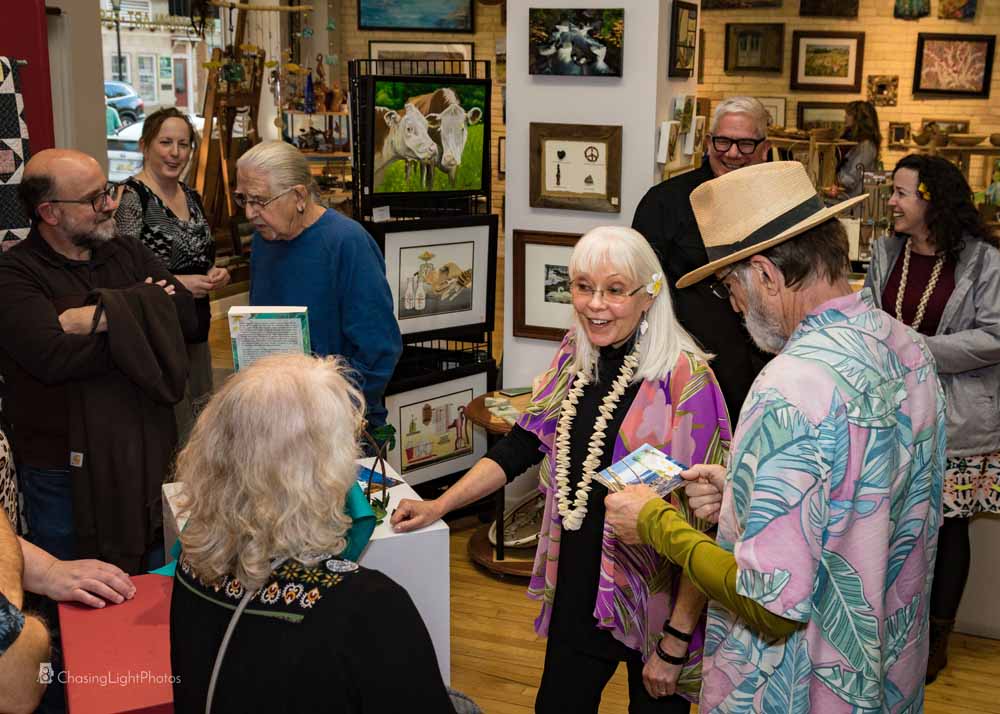 Celebrating with friends at Artsplace. (Photo: Chris Martin at www.chasinglightphotos.net)
 I recently experienced the dream-come-true of celebrating publication of my book, Mango Rash: Coming of Age in the Land of Frangipani and Fanta, with friends and loved ones. Fortunately, the reality was anything but a dud.
It was pure magic.
It was pure magic.
 With yoga friends Linda and Sandy (Photo: Emily Everett)
 Looking back on the occasion, I realize it was more than a book launch. It was equal parts reunion, time capsule, and celebration of friendship.
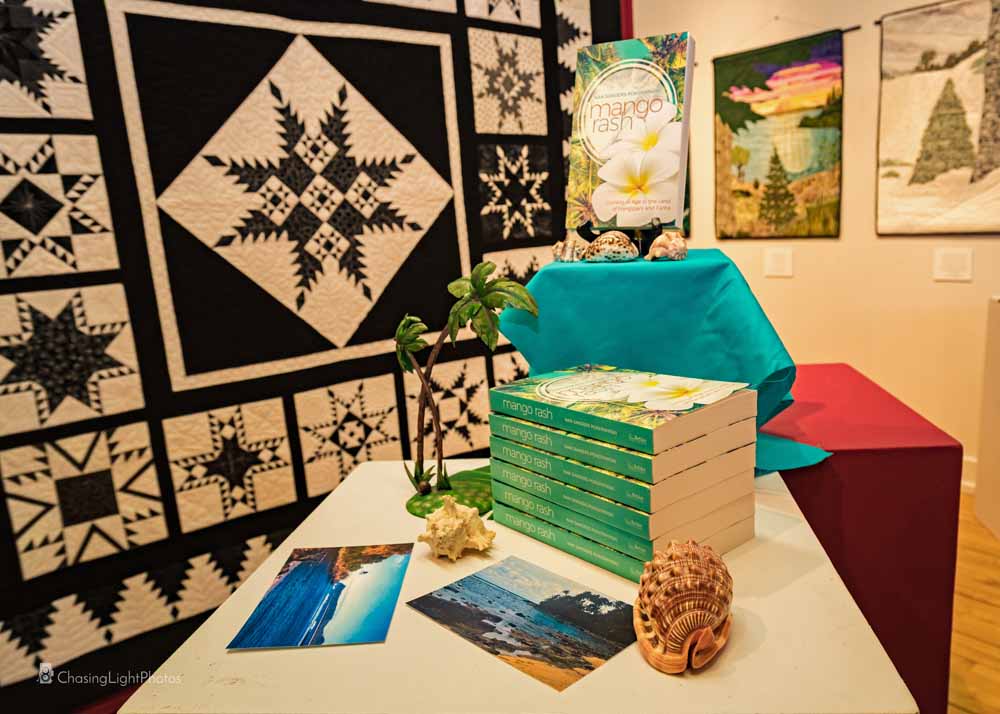 It was a fabulous book party (Photo: Chris Martin at www.chasinglightphotos.net)
 It was, of course, also a fabulous book party. Newaygo County Council for the Arts/Artsplace generously hosted the October 25 event, three days after the official publication date, and Artsplace knows how to throw a party. Everything was set up beautifully (who knew stacks of books could be so artful?), and the mood was festive.
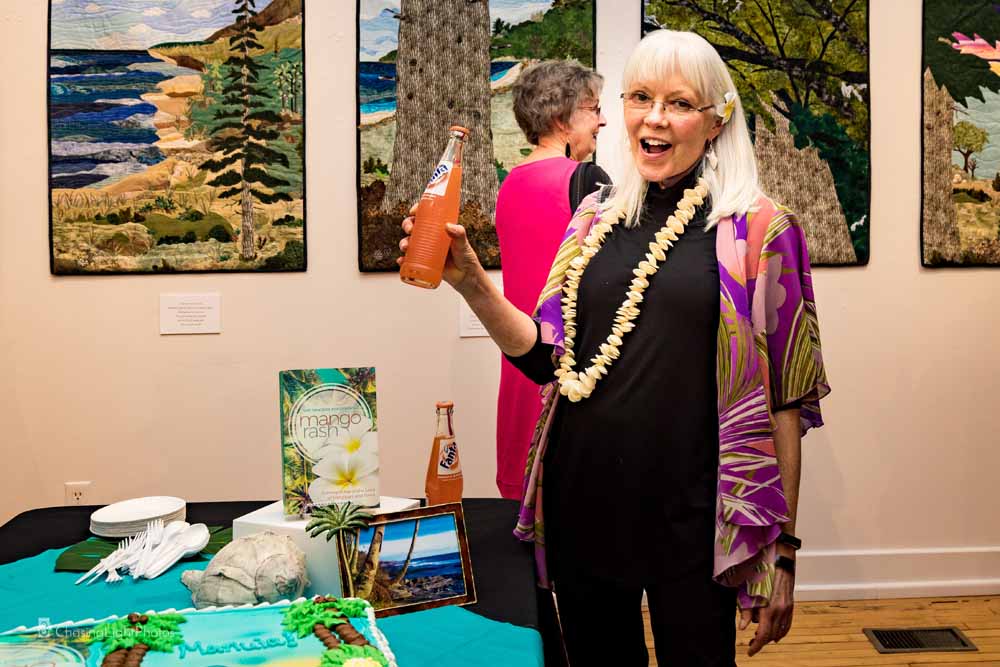
Fun with Fanta (Photo: Chris Martin at www.chasinglightphotos.net)
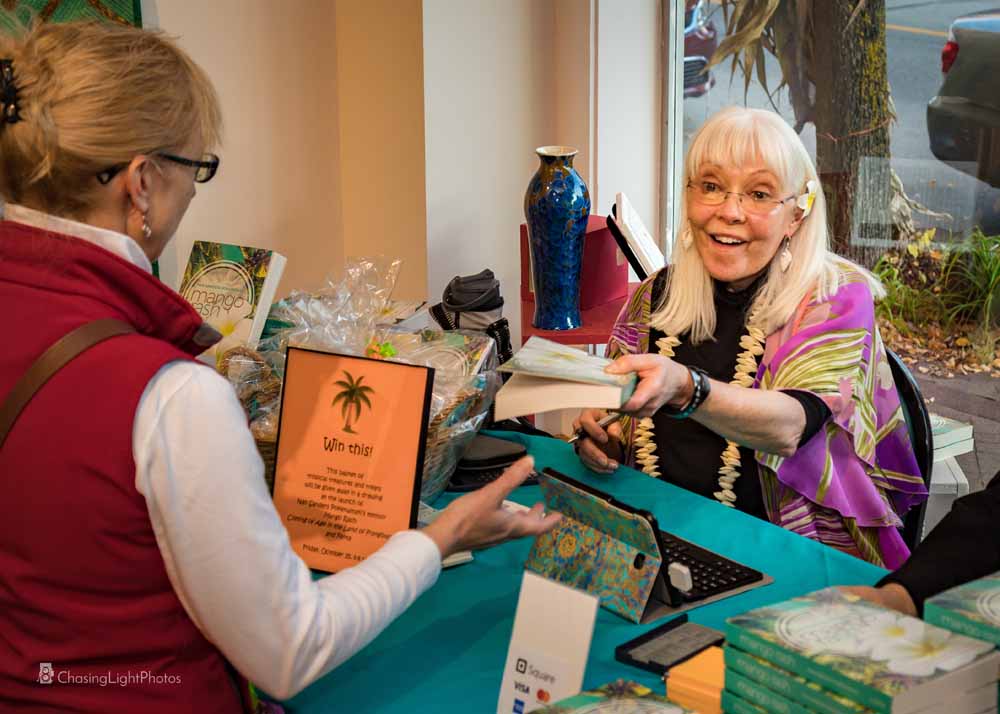
Taking time out from the festivities to, oh yeah, sign books (Photo: Chris Martin at www.chasinglightphotos.net)
 Valerie D and Eileen were among the guests who dressed the part (Photo: Chris Martin at www.chasinglightphotos.net)
 Many guests dressed in tropical attire, adding to the merriment, and my publisher Behler Publications even provided an enormous, lavishly-decorated cake.
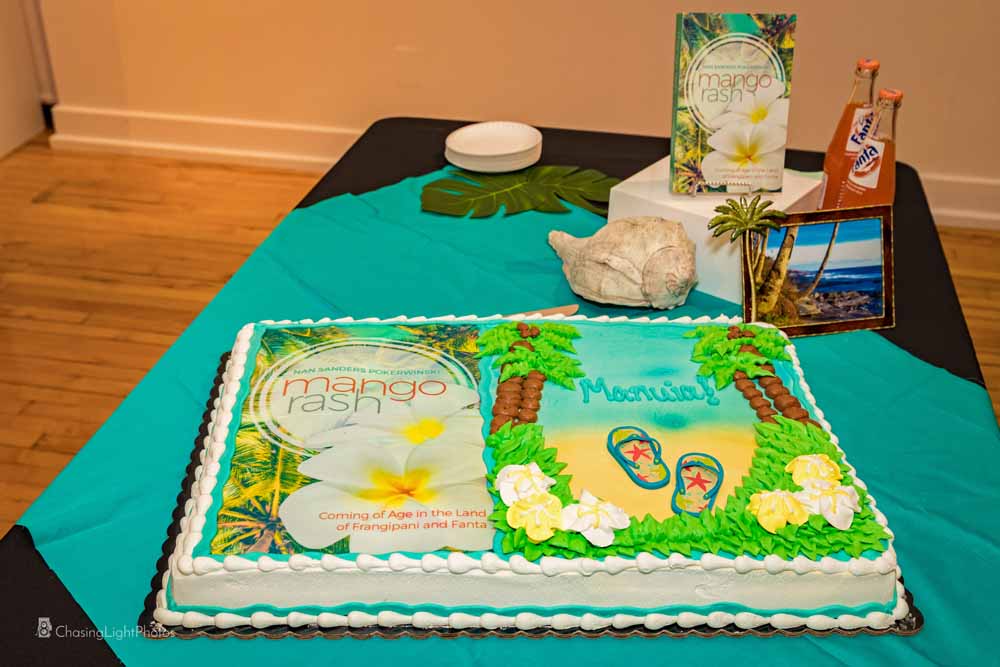
Everyone raved about the banana cream-filled cake (Photo: Chris Martin at
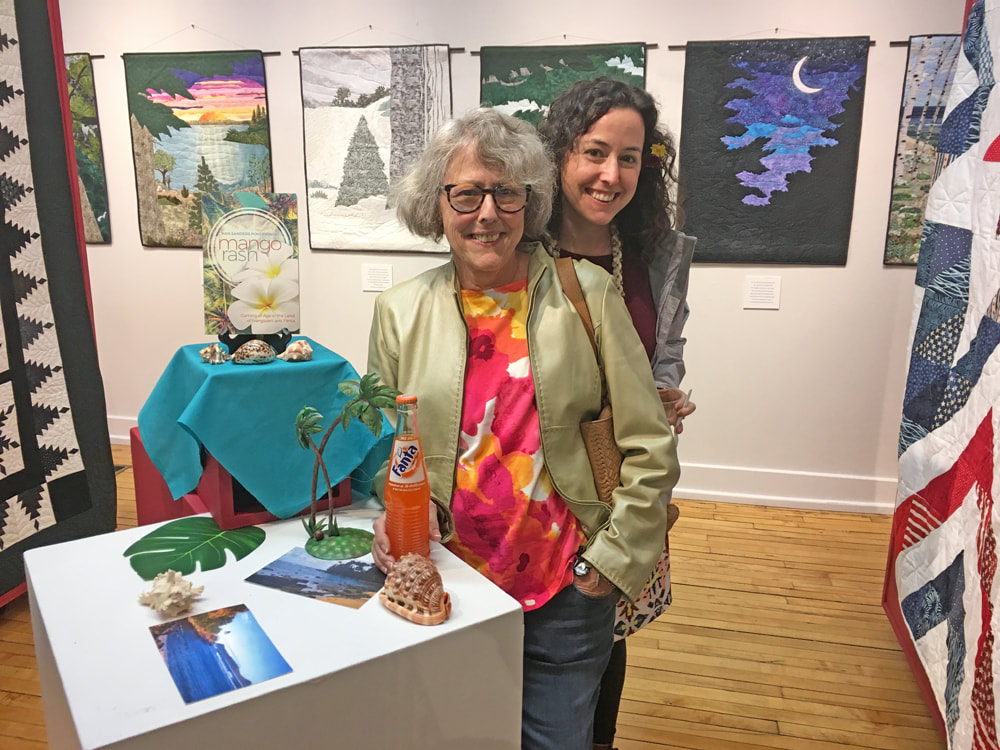 Samoa-Valerie with daughter Ashley, who wins the prize for traveling the farthest -- from Australia (Photo: Emily Everett)
 As for the reunion part, three friends from Samoa days—Valerie, Barry, and Beverly, all of whom are in the book—traveled from afar for Mangorama weekend. Though I had spent time with all three of them in recent years, Val and Bev hadn’t seen each other since Samoa days, more than 50 years ago, and it had been almost that long since Val and Barry last crossed paths.
With Barry and Beverly, who drove up from Texas for this shindig (Photo: Chris Martin at www.chasinglightphotos.net)
 Val and Ashley share a moment over old photos (Photo: Emily Everett)
 As we continued the celebration over the weekend, we reminisced and laughed over pictures (did we really ever look like that?) and reinforced bonds that formed in that remarkable time and place: Samoa in the Sixties.
Looking at pictures with Bev and John, a longtime friend from Detroit days (Photo: Emily Everett)
Other friends from my Detroit and Ann Arbor days also made the scene. That’s where the time capsule comes in. My whole writing life flashed before me, remembering time spent with these friends back in our Detroit Free Press, University of Michigan News Service, and Ann Arbor writers’ group days.
Sally P and Laura, both friends from University of Michigan News Service days, catch up. Laura and I were also in a writers' group together in Ann Arbor. (Photo: Chris Martin at www.chasinglightphotos.net)
A contingent from the Flanigan clan surprised me by showing up unannounced. Flanigans rock! (Photo: Ray Pokerwinski)
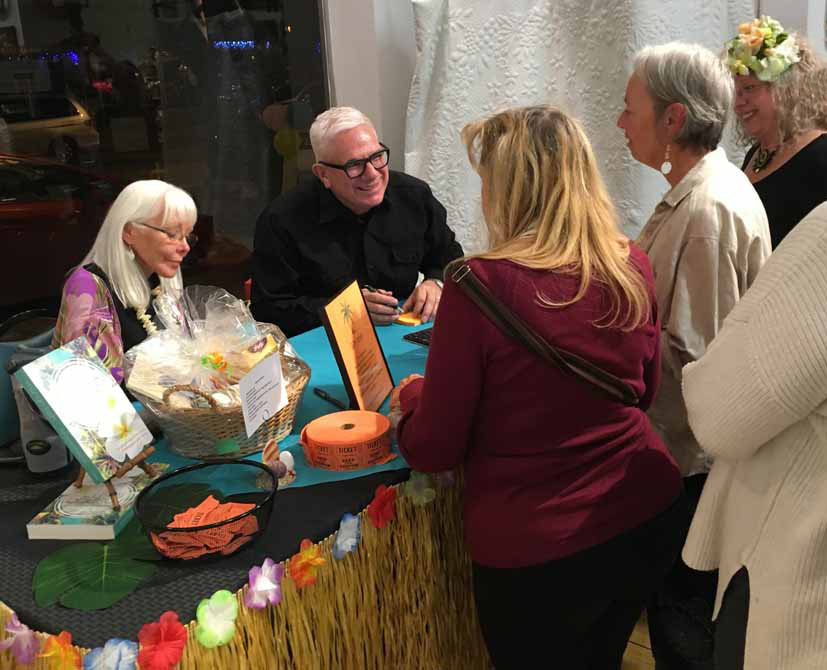
John ably assisted at the book table (Photo: Emily Everett)
Emily, from Detroit days and ever after, picks out a tiki mug, a party favor at the morning-after brunch for out-of-town visitors (Photo: NanSP)
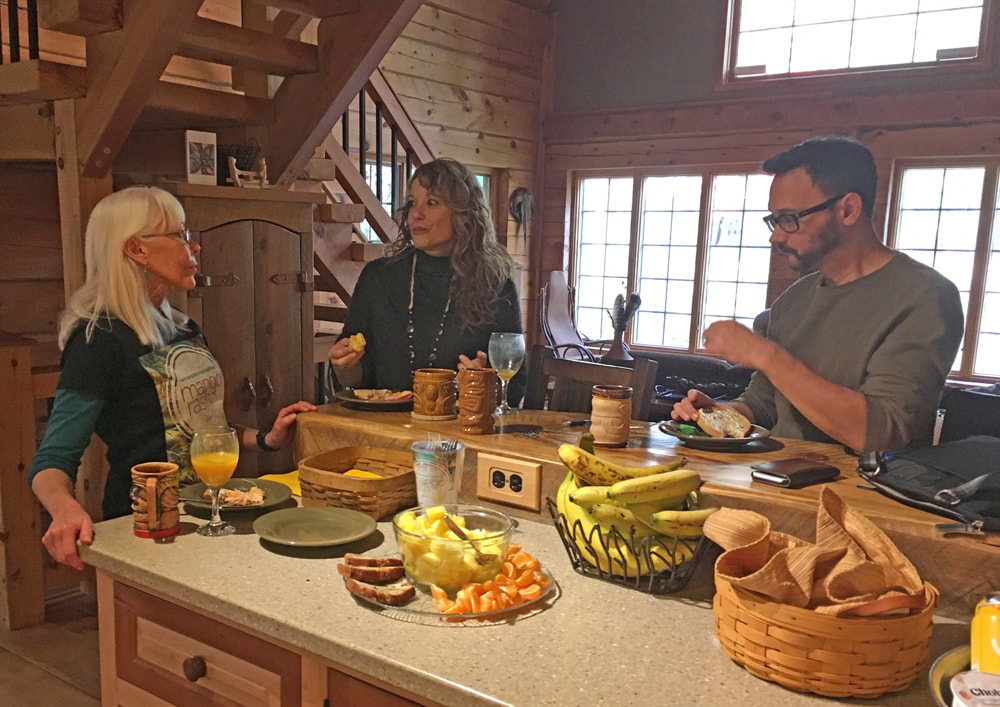
With Laura and Chris from Ann Arbor days (Photo: Emily Everett)
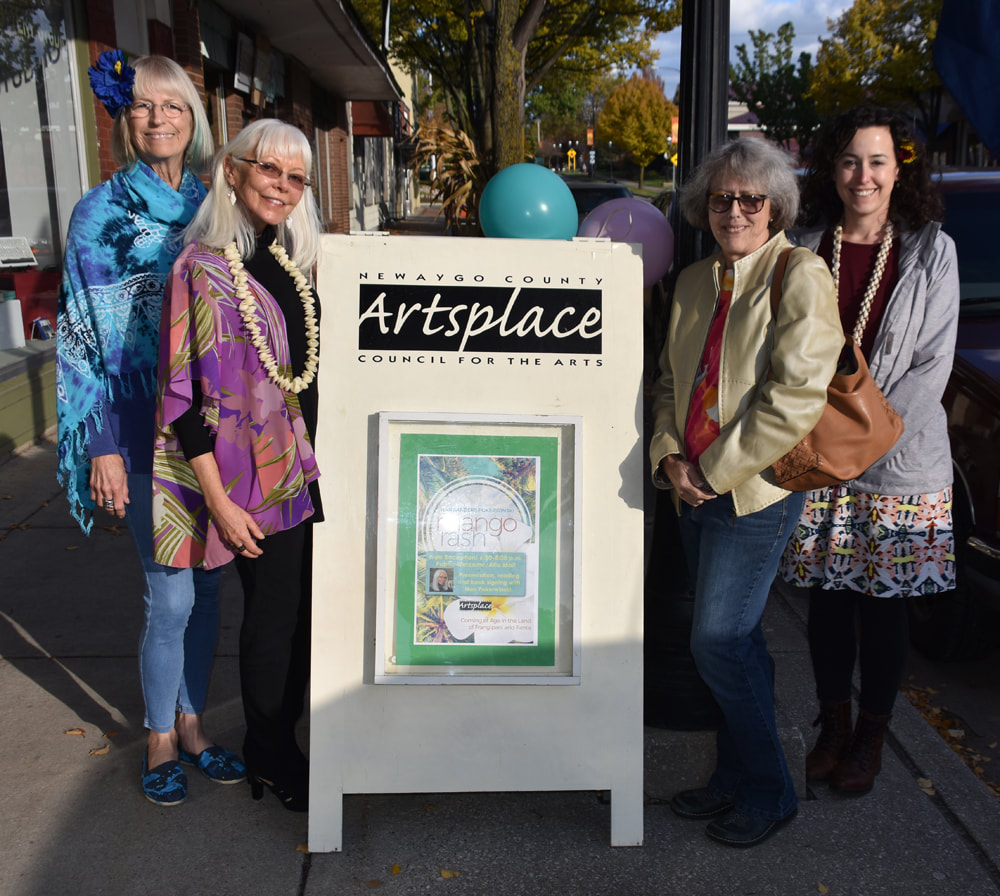
Striking a pose with Emily, Val, and Ashley at Artsplace (Photo: Ray Pokerwinski)
Those flashbacks continued into the following week when I had a second book signing at Artworks in Big Rapids. For several years, I belonged to a writers’ group at Artworks, and during that time I revised the manuscript that became Mango Rash. It was such fun to see friends from the Artworks writer’s group at the reading and for all of us to reflect on the long journey from manuscript to book.
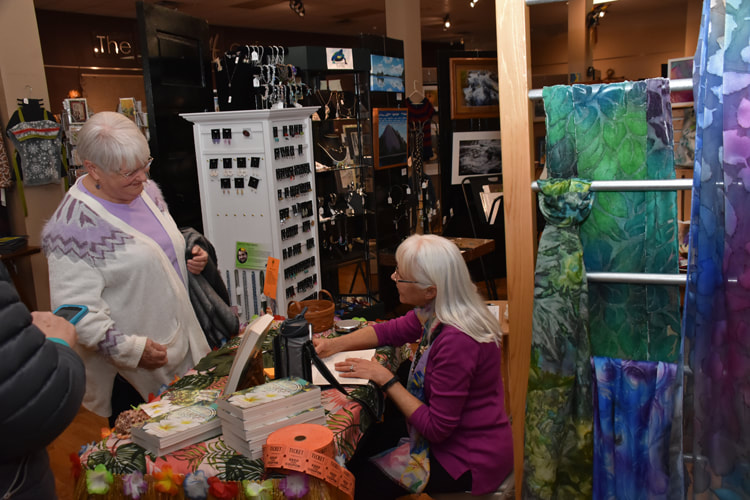
Signing a book for Millie, from the Artworks writers' group (Photo: Ray Pokerwinski)
 With Kendra at Croton Township Library (Photo: Ray Pokerwinski)
 Still more memories came flooding back at the Croton Township Library book signing a few days later, where I connected with another writing friend. Kendra Lachniet and I were in the Fremont Area District Library’s writers’ group together, and Kendra has been supportive of my work all along.
So have all my friends, writers and non-writers alike. Celebrating with them over the past couple of weeks has reminded me over and over how blessed I am to have a circle of such kind, caring, generous, and FUN pals.
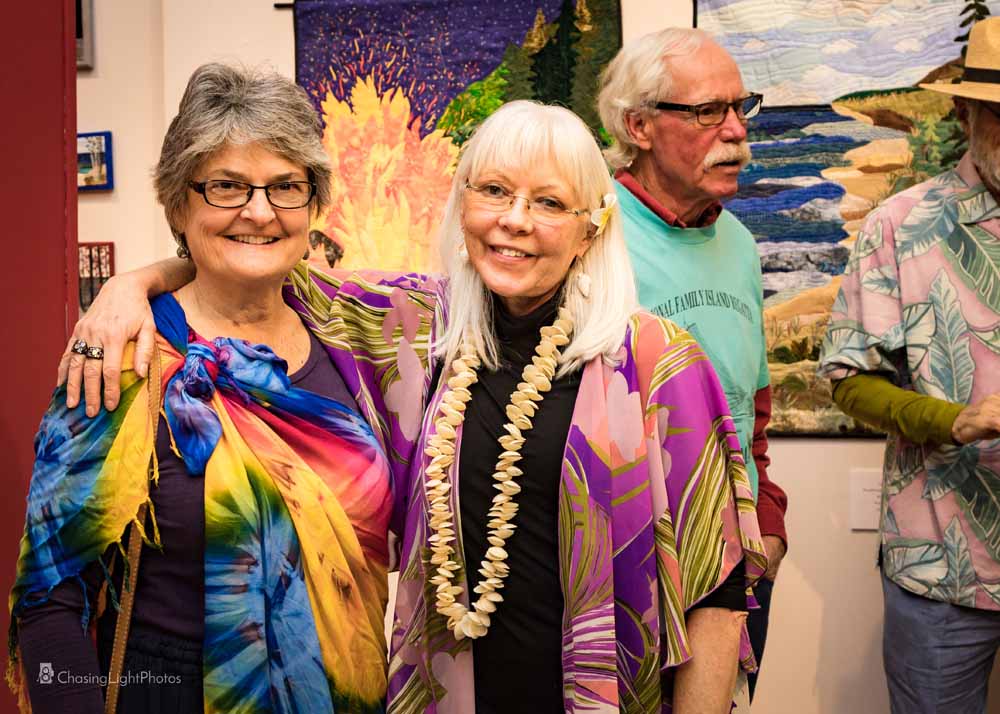 With Kathy at Artsplace (Photo: Chris Martin at www.chasinglightphotos.net) |  With Sally K at Artsplace (Photo: Chris Martin at www.chasinglightphotos.net) |
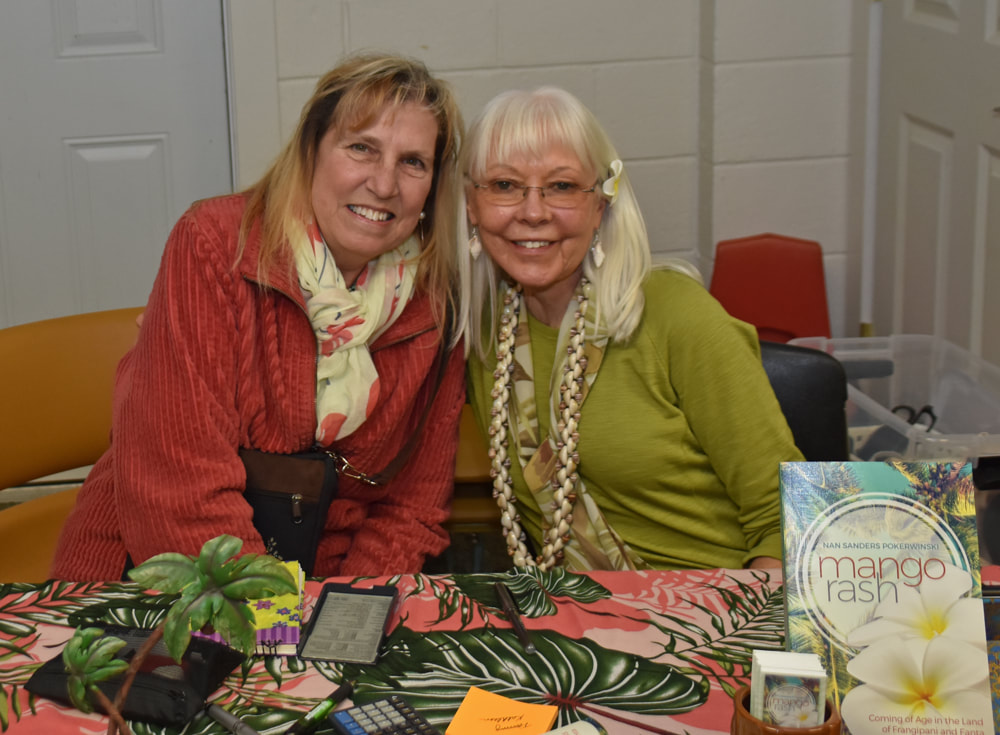 With Tonya at Croton Township Library (Photo: Ray Pokerwinski) | 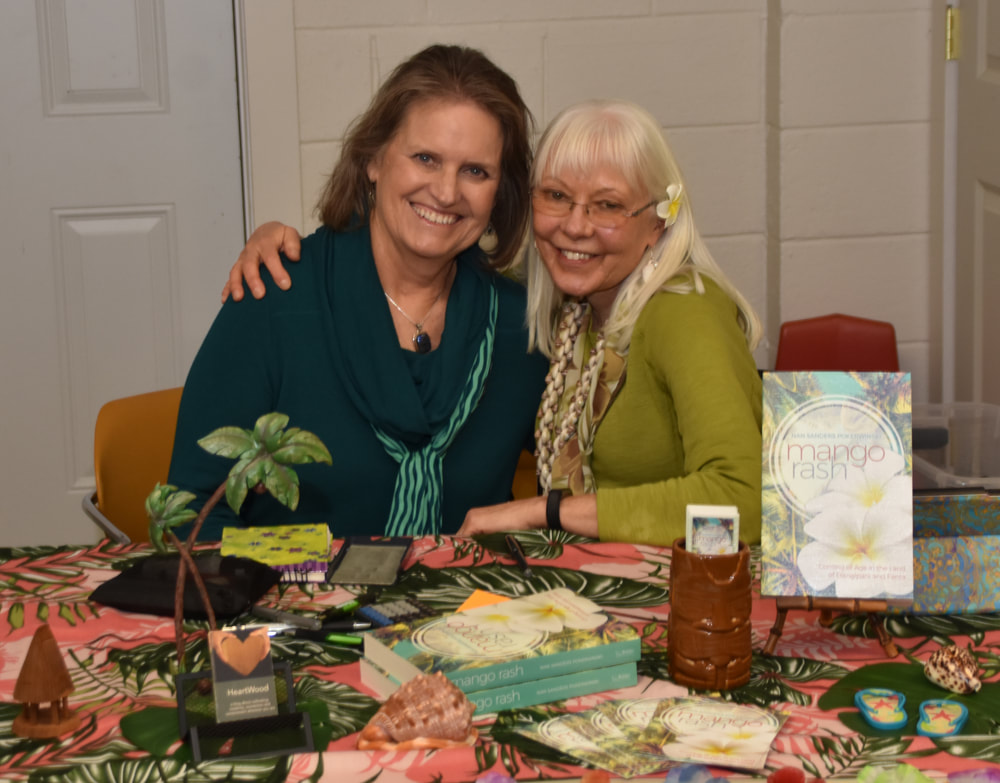 With Sue at Croton Township Library (Photo: Ray Pokerwinski) |
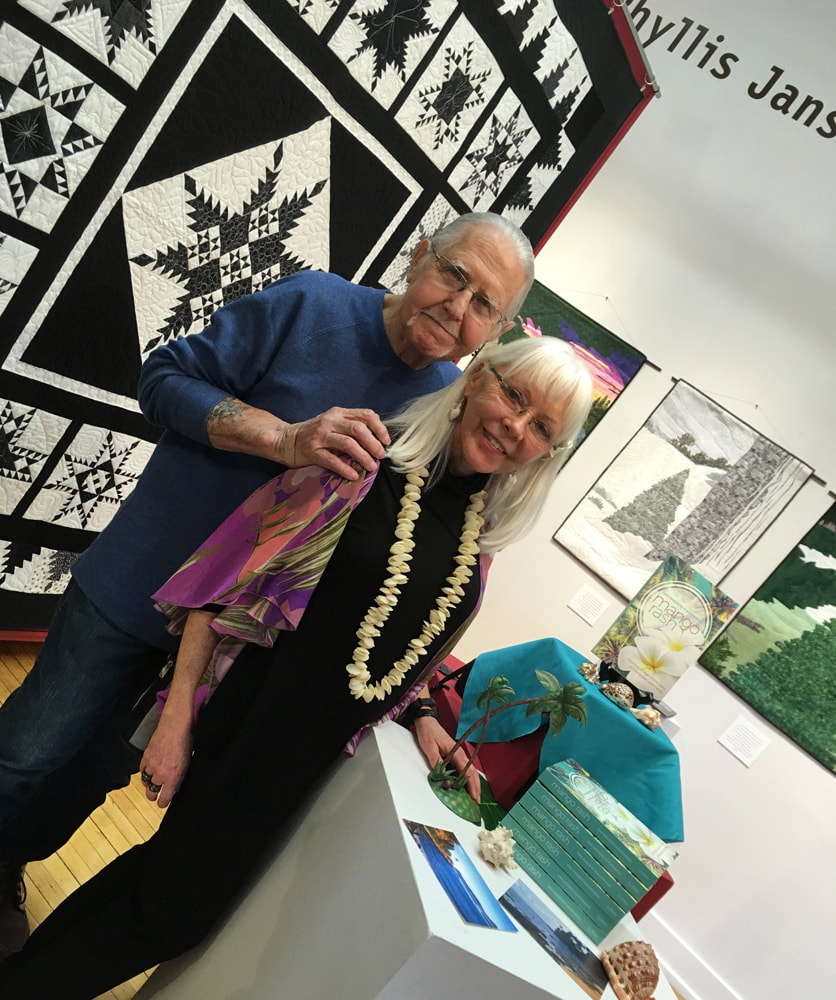
With Ray, Supporter Supreme (Photo: Emily Everett)
Whether or not I published a book, whether or not I ever publish another, I couldn’t ask for more.
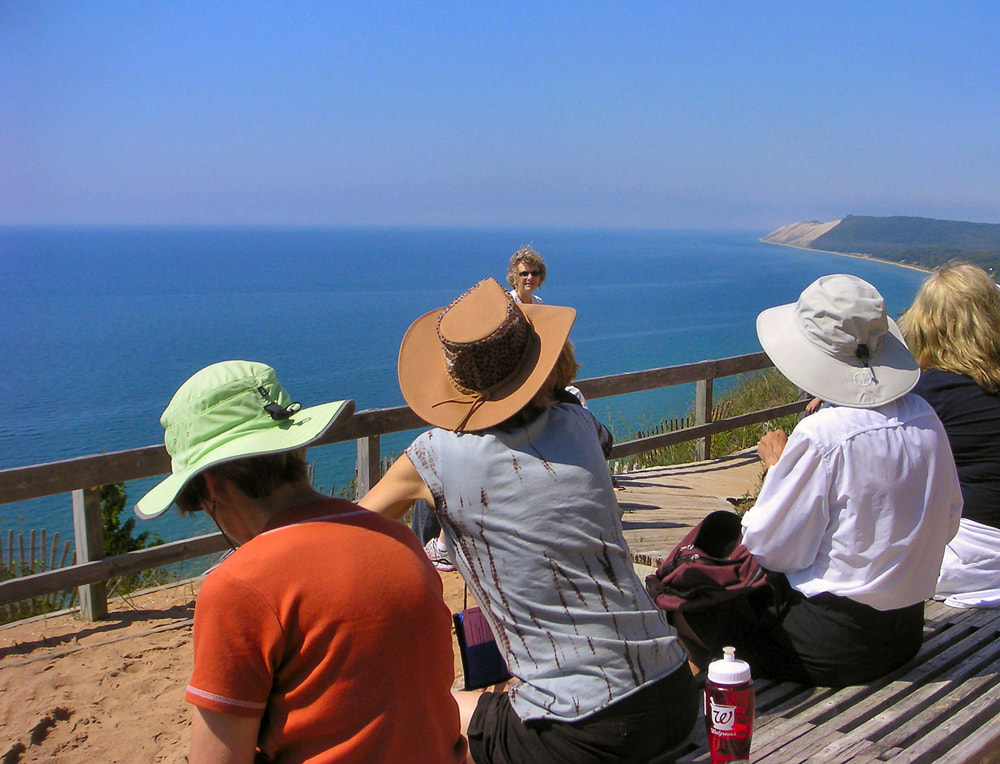 Anne-Marie Oomen leading a writing workshop at Sleeping Bear Dunes on Lake Michigan
 What with summer activities and chores and the myriad details associated with the launch of my memoir Mango Rash, I confess I haven’t been doing much new writing lately. I was inspired to make an exception, though, when I received a compelling request earlier in the summer from one of my favorite Michigan authors, Anne-Marie Oomen.
She was appealing to writers in her circle to join in an undertaking she called the Lake-love Letters Project. The idea was simple: write a love letter—no more than 400 words—to the Great Lakes or a specific lake. Not a huge investment of time and energy, but an important one, as Anne-Marie’s cover letter made clear.
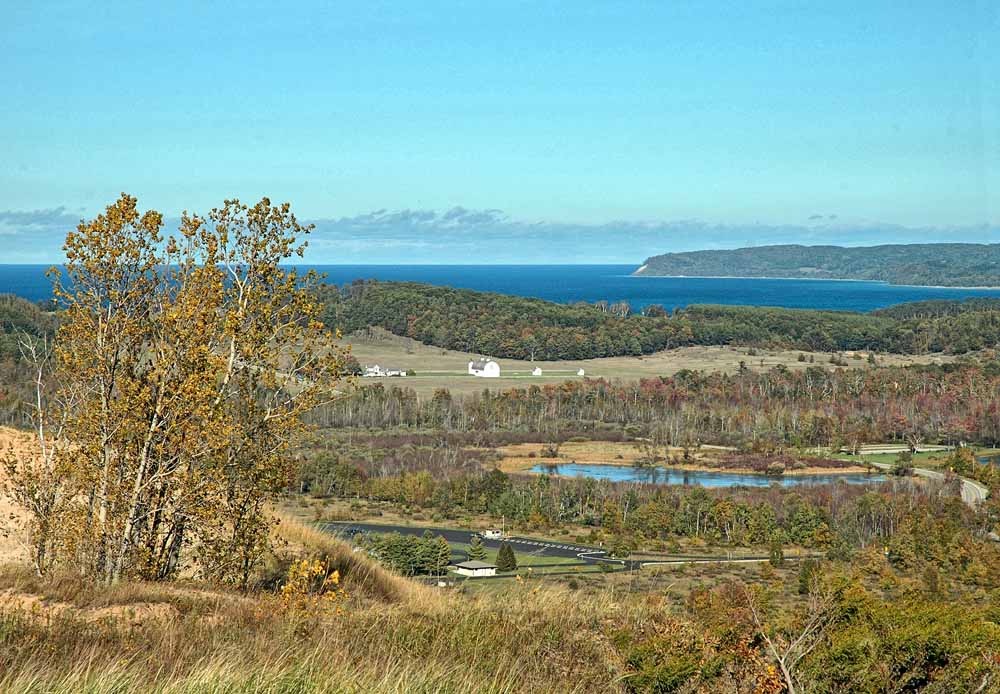
It began:
I love our waters: lakes, rivers, wetlands, little sinking ponds, remote swamps. If it’s wet, I’ll probably like it. And of course, I’m worried about all of them, as I know many of you are. I often wonder what I can do. I’m not a scientist, politician, lawyer, not even a very good journalist. I often feel inadequate, a “fish out of water” when it comes to this work. This year, a question I asked myself: how might I use my small gifts a literary artist (creative writer) to do something for our beloved waters.
I love our waters: lakes, rivers, wetlands, little sinking ponds, remote swamps. If it’s wet, I’ll probably like it. And of course, I’m worried about all of them, as I know many of you are. I often wonder what I can do. I’m not a scientist, politician, lawyer, not even a very good journalist. I often feel inadequate, a “fish out of water” when it comes to this work. This year, a question I asked myself: how might I use my small gifts a literary artist (creative writer) to do something for our beloved waters.
She went on to relate that just as she was considering how she might make a difference, she received a letter from Liz Kirkwood, director of the regional water organization For Love of Water (FLOW). The letter explained that in July, the International Joint Commission of the Great Lakes would meet in Traverse City. Liz wanted to enliven what might otherwise be a dry discussion (subject matter notwithstanding) by involving artists who are passionate about our water.

As Anne-Marie described it in her letter,
She had a vision: at the final meeting with the commissioners, could we showcase our love of water in a way that would involve the arts, particularly the writers. She spoke of the arts as one heart behind all the science and legal work. I was so grateful for her rare understanding. And she offered an idea that I could run with. Could we writers and artists do something with love letters to our waters. Love letters? Yes!
She had a vision: at the final meeting with the commissioners, could we showcase our love of water in a way that would involve the arts, particularly the writers. She spoke of the arts as one heart behind all the science and legal work. I was so grateful for her rare understanding. And she offered an idea that I could run with. Could we writers and artists do something with love letters to our waters. Love letters? Yes!
I usually take my time responding to requests that ask me to write, edit, or critique something. I like to consider what else is on my to-do-list and how interested I am in adding to that ever-expanding list. This time I didn’t hesitate. As soon as I found a sliver of writing time, I drafted my love letter. After a few revisions, I sent it off to Anne-Marie.
Here’s what I wrote:
Here’s what I wrote:
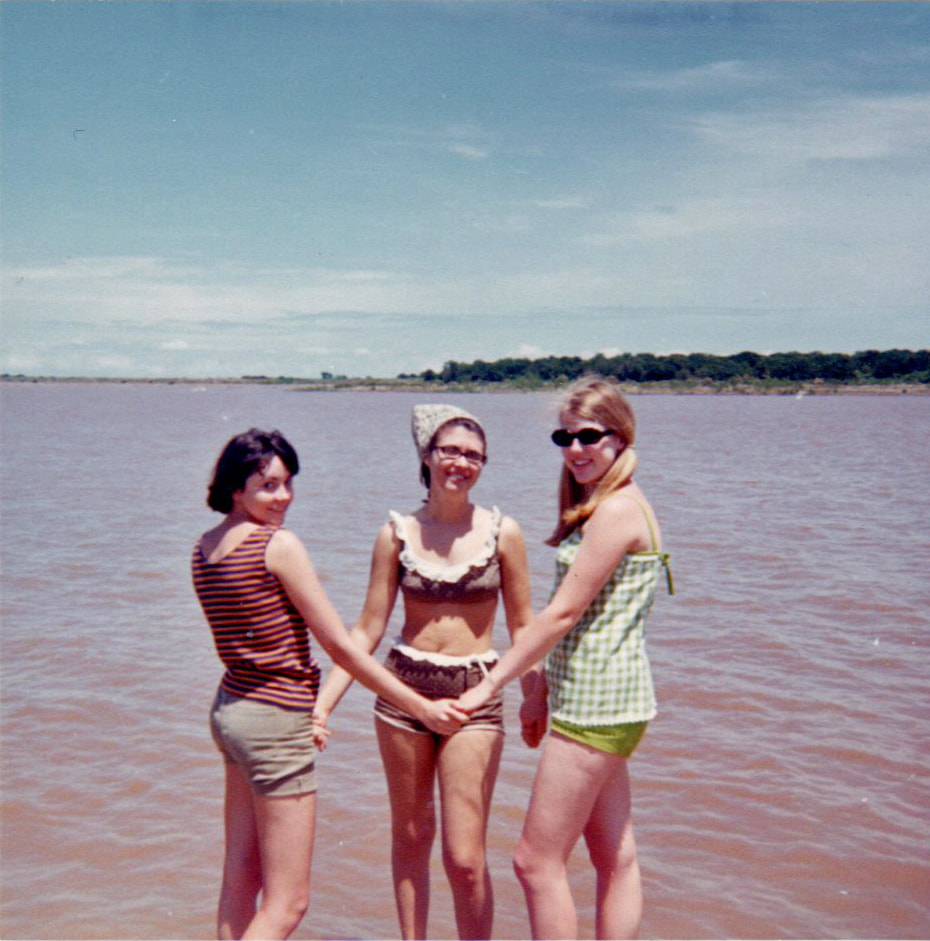 With friends Sarah and Cindi at Lake Carl Blackwell in Oklahoma, circa 1968
 Dear Lake Michigan,
You’re not like the others—the ones I grew up with. In that flat and dusty land, those pretenders to the title were mere puddles. Knowing no better, we suited up, dived in, toweled off, sat on shore with sandwiches, staring out across their dense, red-silted expanses, thinking, “Well, this is nice.”
You’re not like the others—the ones I grew up with. In that flat and dusty land, those pretenders to the title were mere puddles. Knowing no better, we suited up, dived in, toweled off, sat on shore with sandwiches, staring out across their dense, red-silted expanses, thinking, “Well, this is nice.”
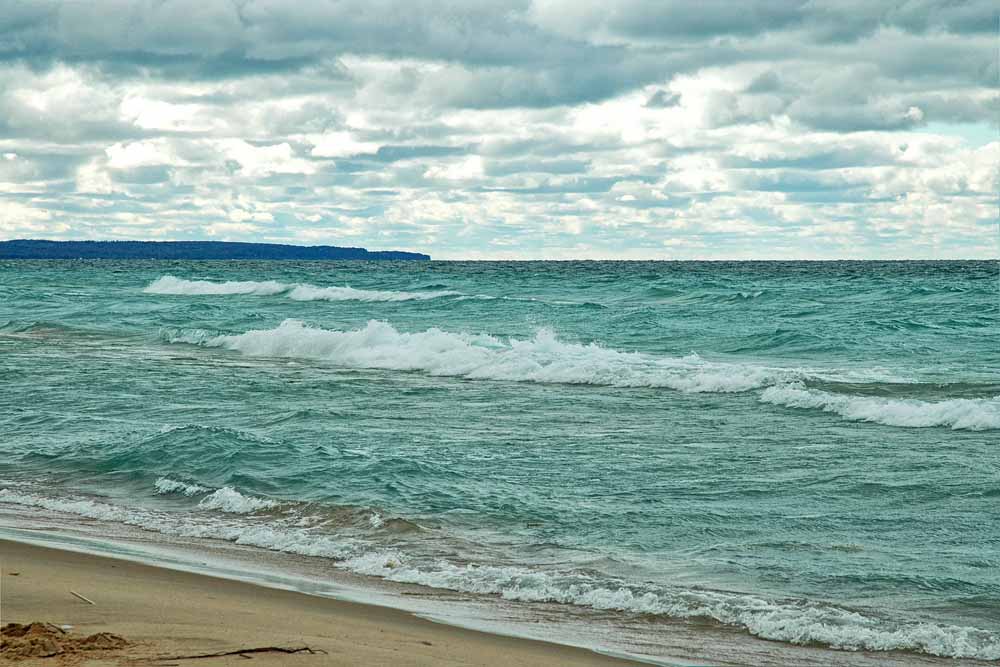
Then I met you, and I had to expand my vocabulary. I’ll admit it: you dazzled me, spangled like a rock star, necklaced with villages whose very names enchant: Empire, Pentwater, Saugatuck.
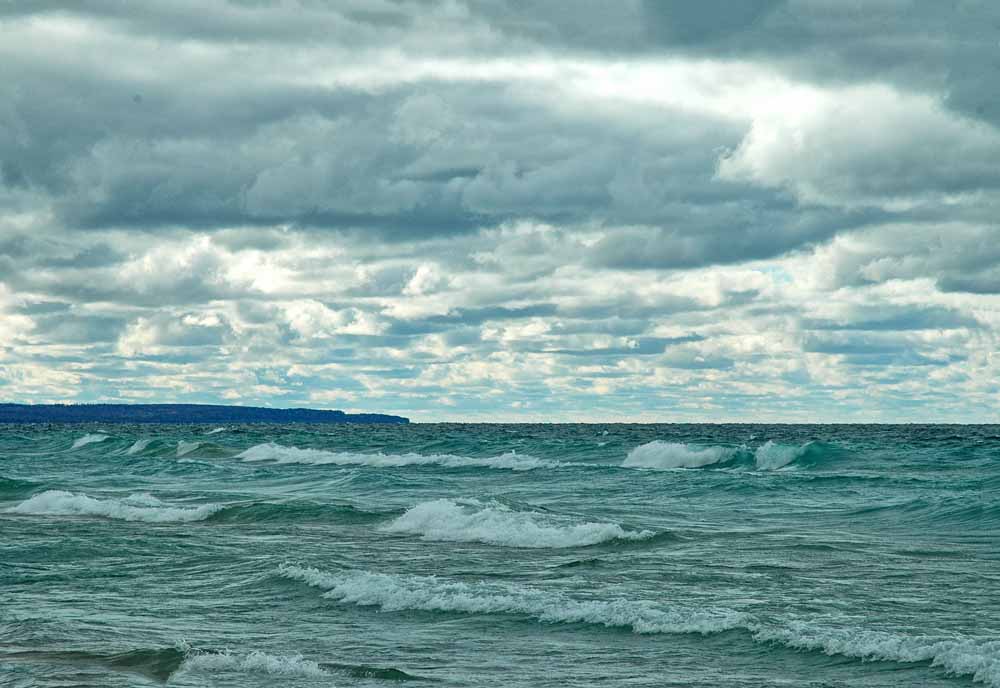
The only time I didn’t love you as much as I wanted to was on that blustery September day I ferried across your liquid skin. Your ups and downs! How they unsettled me. Betrayed, I sulked until I reached the other shore and looked back at your troubled face, your spectrum of shades.
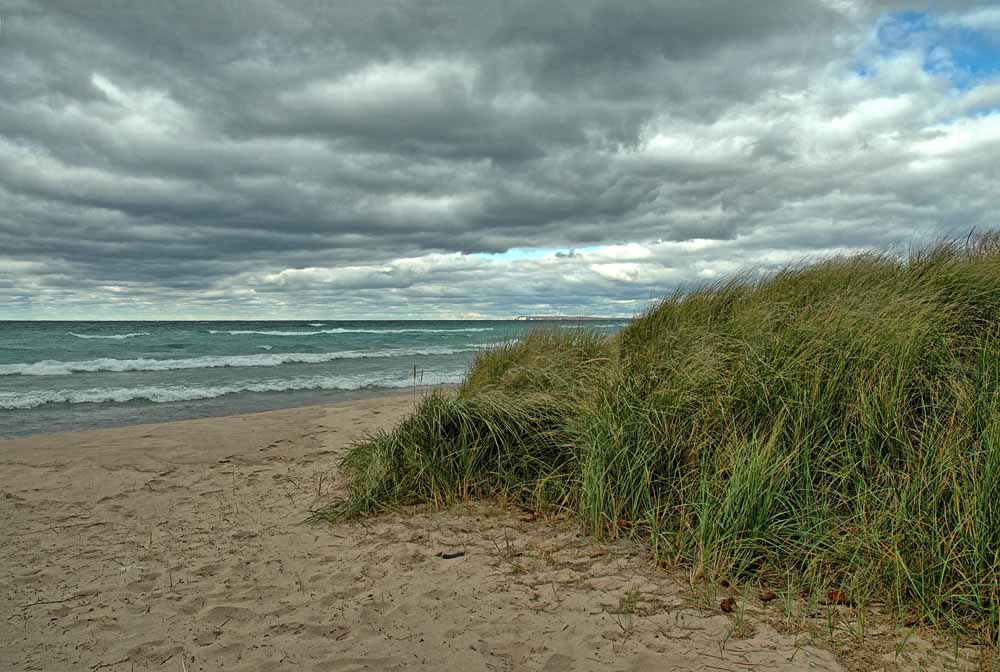
You, too, carry burdens, I realized in that moment. And also this: I may have loved you since we first met, but I haven’t really known you. Let me know you now.
Love,
Nan
Love,
Nan
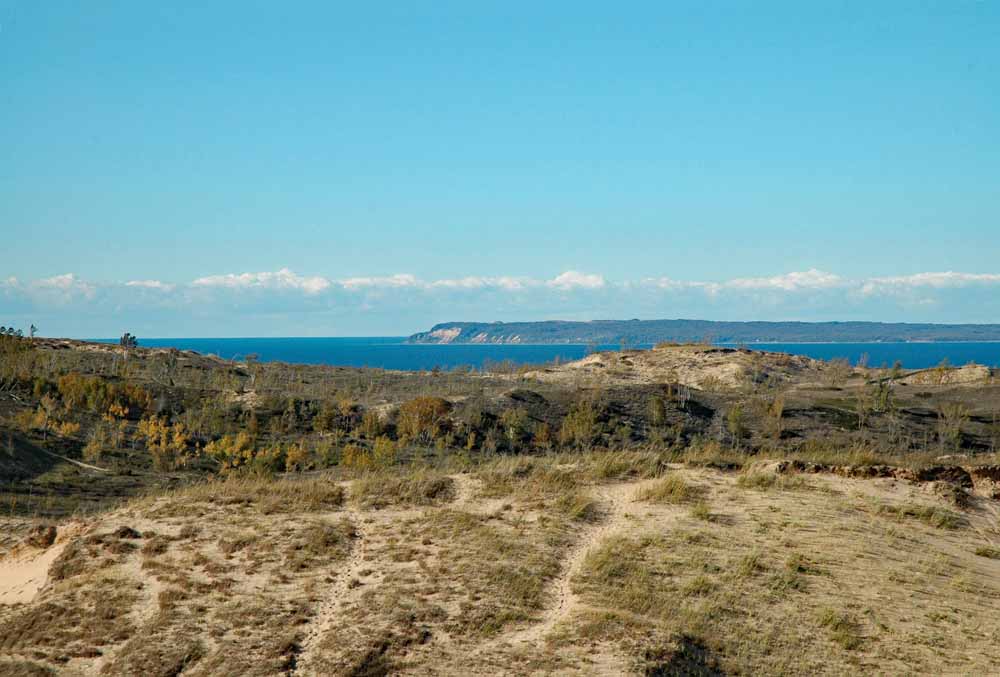
Just before the commission meeting, Anne-Marie reported that nearly 100 letters submitted to the project would be presented in book form to each of the commissioners. In addition, she extracted sentences from some letters and shaped them into a ten-minute script to be read as part of the presentation to the commission. “Your words made a beautiful praise song to the lakes—thank you!” she wrote to contributors.
So often, writing feels like a solitary, inwardly-directed pursuit. It was gratifying to take part in this project, and it made me think about other ways I might merge my passion for writing with the issues I care about.
How can you apply your talents to something you care about?
FLOW’s video of the entire Traverse City meeting can be viewed here. The Lake-love Letters Project portion begins around minute 14 and continues to minute 28. FLOW and the commission also plan to post the entire collection of Lake-love Letters on their websites.
Written from the heart,
from the heart of the woods
from the heart of the woods
Read the introduction to HeartWood here.
Available now!

Check with your favorite bookseller or order from the BUY BOOKS page on this website.
Author
Nan Sanders Pokerwinski, a former journalist, writes memoir and personal essays, makes collages and likes to play outside. She lives in West Michigan with her husband, Ray.
Archives
April 2022
August 2021
July 2021
June 2021
May 2021
April 2021
January 2021
December 2020
November 2020
October 2020
September 2020
August 2020
July 2020
June 2020
May 2020
April 2020
March 2020
February 2020
January 2020
December 2019
November 2019
October 2019
September 2019
August 2019
July 2019
June 2019
May 2019
April 2019
March 2019
February 2019
January 2019
December 2018
November 2018
October 2018
September 2018
August 2018
July 2018
June 2018
May 2018
April 2018
March 2018
February 2018
January 2018
December 2017
November 2017
October 2017
September 2017
August 2017
July 2017
June 2017
May 2017
April 2017
March 2017
February 2017
January 2017
December 2016
November 2016
October 2016
September 2016
August 2016
July 2016
June 2016
May 2016
April 2016
March 2016
February 2016
Categories
All
Art
Better Living
Books
Community
Creativity
Events
Explorations
Food
Gardens
Guest Posts
Health
Inspiration
Last Wednesday Wisdom
Local Artists
Mecosta County
Montcalm County
Music
Muskegon County
Nature
Newaygo County
Oceana County
People
Photography
Pure Michigan
Reflection
Return To Paradise
Samoa
Writing
 RSS Feed